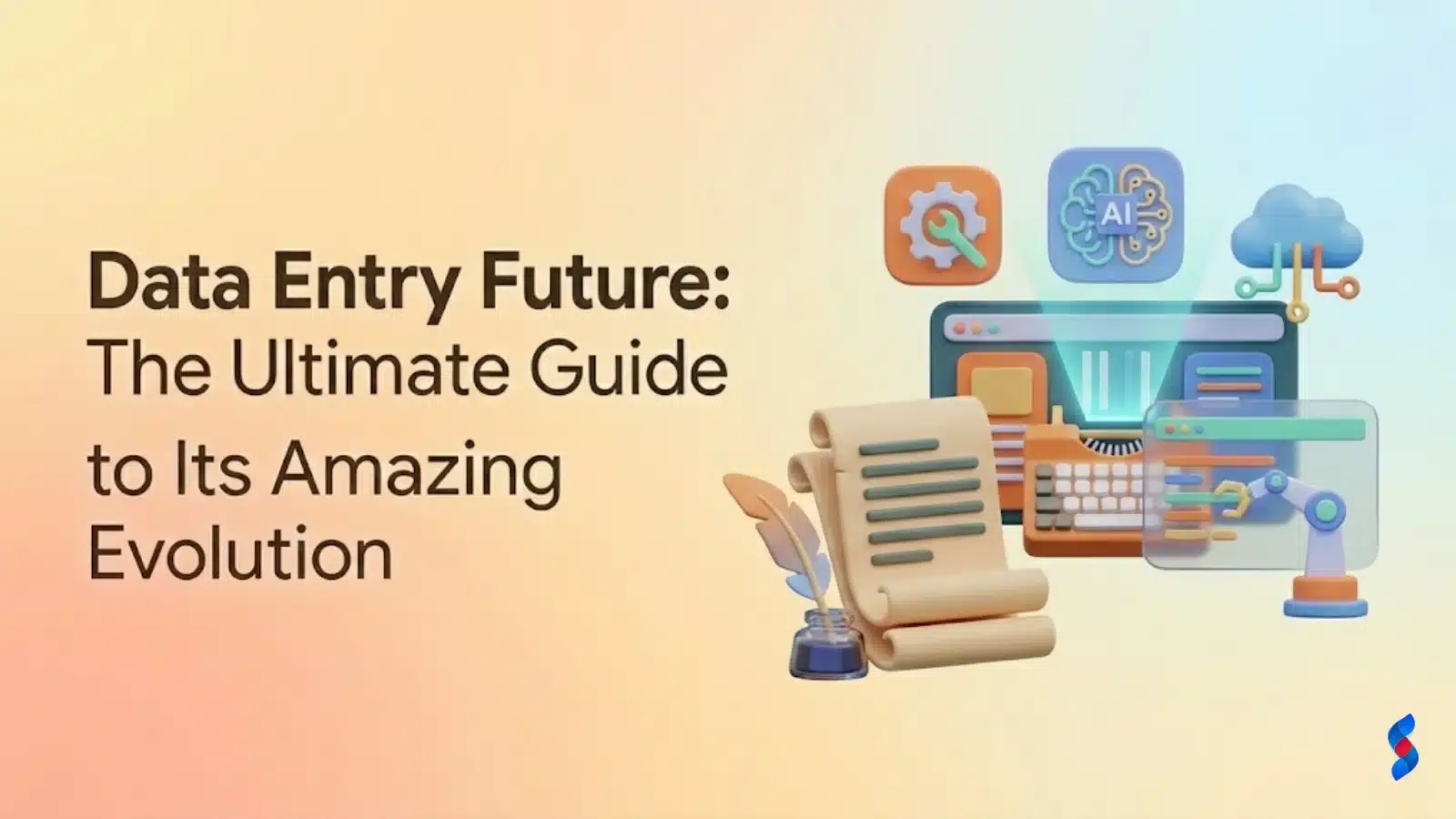
Data Entry Future: The Ultimate Guide to Its Amazing Evolution in 2025
Explore the data entry future! Is it obsolete? Discover how automation and AI are transforming information management. Stay ahead with our insights on the evolving role of data entry in 2025 and beyond.
Data entry, a foundational element of information management, has long been perceived as a domain of manual and repetitive tasks. From meticulously transcribing handwritten notes to populating digital databases, it has been a cornerstone of business operations for decades. The data entry future, however, is poised for a dramatic shift, far exceeding simple automation.
Introduction: Data Entry – From Past to the Present
The traditional perception of data entry involves repetitive manual tasks, often viewed as tedious but essential for organizational efficiency. Traditionally, it conjures images of rooms filled with clerks diligently typing away at typewriters, converting paper-based records into structured data. This process was labor-intensive, time-consuming, and prone to human error. The historical significance of data entry cannot be overstated. It laid the groundwork for modern information systems, enabling businesses and governments to organize, store, and retrieve crucial data. Before the advent of computers, meticulous record-keeping was vital for accounting, inventory management, and customer relations. These early data entry practices, though rudimentary, established the importance of accurate and accessible information.
Data entry has evolved significantly with technology. The transition from typewriters to computers marked a pivotal moment, improving speed and accuracy. Early computers streamlined data processing, but the fundamental task of manual input remained. Subsequent advancements, such as optical character recognition (OCR) and database management systems, further enhanced the efficiency of data entry. Today, we are witnessing the rise of AI-powered automation that promises to redefine the data entry future.
The central question is: Is data entry truly becoming obsolete, or is it undergoing a profound transformation? While some may predict its demise due to automation, we at SkySol Media believe that data entry future is not about elimination but about evolution. It is about augmenting human capabilities with intelligent technologies to create a more efficient, accurate, and strategic approach to information management. This transformation requires new skills, new strategies, and a new understanding of the role of data entry in the modern enterprise.
The Rise of Automation and AI in Data Entry
Automation in the context of data entry refers to the use of technology to perform tasks that were previously done manually. This includes using software, scripts, and robotic process automation (RPA) to automatically input, process, and manage data. Automation aims to reduce human intervention, minimize errors, and accelerate the entire data entry lifecycle. By automating routine tasks, organizations can free up human resources for more complex and strategic activities.
AI is now reshaping data capture and processing. Artificial intelligence is revolutionizing data entry future by enabling machines to learn from data, recognize patterns, and make intelligent decisions. AI-powered data entry tools can automatically extract information from various sources, validate its accuracy, and input it into the appropriate systems. This eliminates the need for manual data entry in many cases, significantly improving efficiency and reducing errors. AI algorithms can also continuously learn and improve, becoming more accurate and efficient over time.
There are several examples of AI-powered data entry tools and software available today. These tools use a combination of machine learning, natural language processing (NLP), and computer vision to automate various data entry tasks.
Intelligent Document Processing (IDP) software: Extracts data from invoices, receipts, and other documents.
Chatbots: Collect customer information and input it directly into CRM systems.
RPA bots: Automate repetitive data entry tasks across multiple applications.
AI-powered OCR: Converts scanned documents and images into editable data with high accuracy.
The benefits of automation in data entry are manifold. Increased efficiency is one of the most significant advantages. Automation can process large volumes of data much faster than humans, reducing processing times and improving overall productivity. Automation also reduces errors. AI-powered systems can validate data and identify inconsistencies, minimizing the risk of inaccurate information. This leads to significant cost savings as a result of reduced rework, improved accuracy, and optimized resource allocation. We have seen clients reduce their data entry costs by up to 60% by implementing AI-powered automation solutions.
Data Entry Skills That Will Thrive in the Future
The skill sets required for data entry professionals are evolving. While basic typing and data entry skills are still important, the data entry future demands a broader range of abilities. Data entry professionals need to be proficient in using various software applications, including data management systems, spreadsheet programs, and automation tools. They must also possess strong analytical and problem-solving skills to identify and resolve data-related issues.
Emphasis on analytical and problem-solving abilities is crucial. The data entry future is not just about inputting data; it’s about understanding it. Data entry professionals need to be able to analyze data, identify trends, and detect anomalies. This requires strong analytical skills and the ability to use data analysis tools. They also need to be able to solve problems related to data quality, data consistency, and data integration.
Data quality and validation expertise are paramount. Ensuring data accuracy and reliability is critical for effective decision-making. Data entry professionals need to be able to validate data, identify errors, and correct them. This requires a thorough understanding of data validation techniques and the ability to use data quality tools. They also need to be able to work with data governance policies and procedures to ensure data integrity.
Adaptability and a willingness to learn new technologies are key skills for thriving in the data entry future. The technology landscape is constantly evolving, and data entry professionals need to be able to adapt to new tools and techniques. This requires a continuous learning mindset and a willingness to embrace change. They also need to be able to stay up-to-date with the latest trends and developments in data management and automation. In our experience at SkySol Media, professionals who embrace learning and quickly adapt to new technologies are the ones who succeed in the long run.
Key Technologies Driving the Future of Data Entry
Robotic Process Automation (RPA) is having a significant impact on data entry tasks. RPA involves using software robots or “bots” to automate repetitive tasks across multiple applications. These bots can mimic human actions, such as clicking buttons, entering data, and extracting information from websites and documents. RPA can automate a wide range of data entry tasks, from invoice processing to customer onboarding, significantly improving efficiency and reducing errors.
Optical Character Recognition (OCR) and Intelligent Character Recognition (ICR) are essential technologies for converting scanned documents and images into editable data. OCR technology can recognize printed characters, while ICR can recognize handwritten characters. These technologies are used to automate the extraction of data from invoices, receipts, forms, and other documents. AI-powered OCR and ICR solutions can achieve high levels of accuracy, even with complex or poorly formatted documents.
Natural Language Processing (NLP) is used for unstructured data extraction. NLP enables computers to understand and process human language. This technology is used to extract information from unstructured data sources, such as emails, social media posts, and customer reviews. NLP algorithms can identify key entities, relationships, and sentiments within unstructured text, making it possible to automate data extraction and analysis.
Machine Learning (ML) algorithms are employed for data pattern recognition and prediction. ML algorithms can learn from data and identify patterns that are not readily apparent to humans. These algorithms are used to predict future outcomes, detect anomalies, and personalize customer experiences. In the context of data entry, ML can be used to identify and prevent errors, predict data entry volumes, and optimize data processing workflows.
Industries Where Data Entry Remains Crucial
In healthcare, maintaining accurate patient records and managing medical data is critical for providing quality care. Data entry remains crucial for updating patient information, processing insurance claims, and managing medical histories. While AI-powered systems can automate some data entry tasks, human oversight is still needed to ensure accuracy and compliance. The data entry future in healthcare involves a combination of automation and human expertise.
Finance relies heavily on data entry for processing transactions, managing accounts, and ensuring regulatory compliance. Banks, investment firms, and insurance companies process vast amounts of data every day, requiring efficient and accurate data entry processes. Automation is increasingly being used to streamline these processes, but human expertise is still needed for complex transactions and regulatory reporting. Our team in Dubai has extensive experience in implementing automated solutions for financial institutions, ensuring compliance with local regulations.
E-commerce depends on efficient data entry for handling customer orders, managing inventory, and coordinating logistics. Online retailers process thousands of orders every day, requiring accurate data entry to ensure timely delivery and customer satisfaction. Automation is used to streamline order processing, track inventory, and manage shipping logistics. However, human intervention is still needed for handling complex orders and resolving customer issues.
Government agencies manage vast amounts of citizen data, public records, and administrative information. Data entry is essential for maintaining accurate records, processing applications, and providing public services. Automation is being used to improve efficiency and reduce costs, but human oversight is still needed to ensure data privacy and compliance.
A common misconception is that data entry is becoming obsolete in specific sectors. While automation is transforming data entry, it is not eliminating the need for human expertise. In many cases, automation is augmenting human capabilities, allowing data entry professionals to focus on more complex and strategic tasks. For example, in healthcare, AI can automate the extraction of data from medical records, but human professionals are still needed to validate the accuracy of the data and ensure compliance with regulations.
The Evolving Role of Data Entry Professionals
The role of data entry professionals is moving beyond basic data input. While accurate data input remains a core responsibility, the data entry future demands a broader skillset. Data entry professionals are increasingly becoming data analysts, data validators, and data curators. They are responsible for ensuring the accuracy, completeness, and consistency of data.
Data entry specialists are evolving into data curators and quality controllers. They are responsible for identifying and resolving data quality issues, ensuring that data is accurate, complete, and consistent. This requires a strong understanding of data validation techniques and the ability to use data quality tools. They also need to be able to work with data governance policies and procedures to ensure data integrity.
Collaboration with AI systems is becoming increasingly important. The data entry future involves humans and machines working together to achieve common goals. Data entry professionals need to be able to work with AI-powered systems, providing human oversight and training to ensure that the systems are accurate and effective. This requires a strong understanding of AI concepts and the ability to communicate effectively with AI developers and data scientists.
There are numerous career paths and opportunities for skilled data entry professionals. As the role of data entry evolves, new career opportunities are emerging. Data entry professionals can specialize in areas such as data analysis, data validation, data governance, and AI training. They can also move into management roles, overseeing data entry teams and implementing data management strategies.
Common Misconceptions About the Data Entry Future
One common myth is that data entry is completely replaceable by automation. The reality is that human oversight is still critical. While automation can handle many routine data entry tasks, it cannot replace human judgment, critical thinking, and problem-solving skills. Human professionals are needed to validate data, identify errors, and resolve complex issues. Automation should be viewed as a tool to augment human capabilities, not to replace them entirely.
Another myth is that no new skills are needed for data entry. The reality is that adaptability and tech proficiency are essential. The data entry future demands a broader range of skills than basic typing and data entry. Data entry professionals need to be proficient in using various software applications, including data management systems, spreadsheet programs, and automation tools. They also need to possess strong analytical and problem-solving skills to identify and resolve data-related issues.
These myths can be debunked with real-world examples and statistics. For example, a recent study by Gartner found that while automation can reduce data entry costs by up to 60%, it also requires significant investment in training and development to ensure that employees have the skills needed to work with AI-powered systems. This highlights the importance of investing in human capital to ensure the success of automation initiatives.
> “The future of data entry lies in the seamless integration of human expertise and artificial intelligence, creating a synergy that enhances accuracy, efficiency, and strategic decision-making.” – Dr. Anya Sharma, Data Science Innovator
Data Security and Ethical Considerations in Automated Data Entry
Addressing data privacy concerns is paramount when implementing automation. Automation can increase the risk of data breaches and privacy violations if not implemented properly. Organizations need to ensure that their automation systems comply with data privacy regulations, such as GDPR and CCPA. This requires implementing robust security measures to protect sensitive information and providing transparency to data subjects about how their data is being used.
Implementing robust security measures is essential to protect sensitive information. This includes using encryption to protect data in transit and at rest, implementing access controls to restrict access to sensitive data, and monitoring systems for suspicious activity. Organizations also need to conduct regular security audits to identify and address vulnerabilities in their automation systems.
The ethical implications of AI in data processing and decision-making must be carefully considered. AI algorithms can be biased, leading to unfair or discriminatory outcomes. Organizations need to ensure that their AI algorithms are fair, transparent, and accountable. This requires using diverse datasets to train AI algorithms, monitoring algorithms for bias, and providing explanations for AI-driven decisions.
Ensuring compliance with data protection regulations, such as GDPR and CCPA, is critical. These regulations require organizations to protect the privacy of personal data and provide data subjects with certain rights, such as the right to access, correct, and delete their data. Organizations need to implement policies and procedures to comply with these regulations, including data breach notification procedures and data subject access request procedures.
The Impact of Remote Work on Data Entry
The shift towards remote data entry roles has accelerated in recent years. Remote work offers numerous benefits, including increased flexibility, reduced costs, and access to a wider talent pool. However, it also presents challenges, such as ensuring data security, maintaining productivity, and fostering team collaboration. The data entry future is increasingly intertwined with remote work.
Tools and technologies that facilitate remote data entry include cloud-based data management systems, virtual private networks (VPNs), and collaboration platforms. Cloud-based systems allow data entry professionals to access data from anywhere with an internet connection. VPNs provide secure connections to corporate networks, protecting sensitive data from unauthorized access. Collaboration platforms enable remote teams to communicate, share files, and manage projects effectively.
There are challenges and opportunities in managing remote data entry teams. Challenges include ensuring data security, monitoring productivity, and maintaining team cohesion. Opportunities include accessing a wider talent pool, reducing costs, and improving employee satisfaction. Effective management of remote data entry teams requires clear communication, strong leadership, and the use of appropriate technology.
Ensuring data security and compliance in remote work environments is crucial. Organizations need to implement robust security measures to protect sensitive data from unauthorized access. This includes using encryption, implementing access controls, and monitoring systems for suspicious activity. They also need to provide training to remote workers on data security best practices and ensure that they comply with data protection regulations.
Case Studies: Successful Implementations of AI in Data Entry
Let’s explore real-world examples of companies leveraging AI for data entry efficiency. These case studies demonstrate the tangible benefits of AI implementation and provide valuable insights for organizations considering adopting similar solutions.
Healthcare Provider: A large healthcare provider implemented an AI-powered IDP solution to automate the extraction of data from medical records. This resulted in a 70% reduction in manual data entry time and a 99% accuracy rate.
Financial Institution: A leading bank implemented an RPA solution to automate the processing of loan applications. This reduced processing times by 50% and improved customer satisfaction scores.
E-commerce Retailer: An online retailer implemented an AI-powered chatbot to collect customer information and input it directly into their CRM system. This reduced customer service costs by 30% and improved lead generation.
Quantifiable results include improved accuracy, reduced costs, and faster processing times. AI-powered data entry solutions can significantly improve accuracy by reducing human error. They can also reduce costs by automating routine tasks and freeing up human resources for more strategic activities. Faster processing times lead to improved efficiency and customer satisfaction.
There are several lessons learned and best practices for implementing AI in data entry. First, it is important to define clear goals and objectives for the AI implementation. Second, it is important to select the right AI tools and technologies for the specific data entry tasks. Third, it is important to provide adequate training and support to employees who will be working with the AI systems. Fourth, it is important to monitor the performance of the AI systems and make adjustments as needed.
At SkySol Media, we have had the opportunity to witness innovation firsthand through our work with clients. For example, we helped a logistics company streamline their invoice processing by implementing an AI-powered IDP solution. This reduced their invoice processing time by 80% and eliminated manual errors, resulting in significant cost savings and improved efficiency. This also allowed them to reallocate resources toward higher-value tasks, furthering their digital transformation.
Future Trends and Predictions for Data Entry
The continued growth of AI and automation is inevitable. AI will become even more sophisticated and capable, automating a wider range of data entry tasks. This will require data entry professionals to adapt to new roles and responsibilities, focusing on data analysis, data validation, and AI training.
The integration of data entry with other business processes will become more seamless. Data entry will no longer be viewed as a separate function but as an integral part of the overall business process. This will require data entry professionals to collaborate more closely with other departments and to have a broader understanding of the business.
New data entry roles and specializations will emerge. As the role of data entry evolves, new career opportunities will emerge. Data entry professionals can specialize in areas such as data analysis, data validation, data governance, and AI training. They can also move into management roles, overseeing data entry teams and implementing data management strategies. The data entry future offers a dynamic landscape.
The importance of continuous learning and adaptation for data entry professionals cannot be overstated. The technology landscape is constantly evolving, and data entry professionals need to be able to adapt to new tools and techniques. This requires a continuous learning mindset and a willingness to embrace change. They also need to be able to stay up-to-date with the latest trends and developments in data management and automation.
Trend
Description
Impact on Data Entry
Hyperautomation
Combining RPA, AI, and other advanced technologies to automate end-to-end business processes.
Automates complex data entry workflows, reducing human intervention and improving efficiency.
Low-Code/No-Code Platforms
Enables citizen developers to build and deploy data entry applications without extensive coding knowledge.
Democratizes data entry automation, empowering business users to create custom solutions.
Edge Computing
Processing data closer to the source, reducing latency and improving real-time data entry.
Enables faster and more responsive data entry in remote locations and IoT environments.
Blockchain Technology
Securing and verifying data transactions using distributed ledger technology.
Enhances data integrity and transparency in data entry processes, reducing the risk of fraud and errors.
Conclusion: Embracing the Transformation of Data Entry
In summary, the data entry future is not about the end of data entry, but about its transformation. We’ve explored how AI and automation are reshaping the field, requiring new skills and creating new opportunities. The key takeaways include the importance of data quality, the need for adaptability, and the value of human oversight in an increasingly automated environment.
Adapting to new technologies and skills is crucial for success in the data entry future. Embrace continuous learning, develop your analytical abilities, and become proficient in using AI-powered tools. The professionals who do this will thrive in the evolving landscape.
Data entry professionals remain valuable in the age of automation. Their role is evolving, but their expertise is still needed to ensure data accuracy, validate results, and provide human oversight. By embracing new technologies and developing new skills, data entry professionals can continue to make valuable contributions to their organizations.
We at SkySol Media are committed to helping businesses navigate this transformation and leverage the power of AI to improve their data management processes.
Q: Is data entry really going to disappear completely?
A: No, data entry future is not about complete disappearance, but rather a shift in focus. While automation will handle many routine tasks, human oversight and expertise will still be needed for complex data validation, analysis, and problem-solving.
Q: What skills should I focus on to stay relevant in the data entry future?
A: Focus on developing analytical and problem-solving skills, becoming proficient in data management systems and automation tools, and embracing continuous learning to stay up-to-date with new technologies.
Q: How can AI improve data entry accuracy?
A: AI-powered systems can validate data, identify errors, and correct them automatically, minimizing the risk of inaccurate information. They can also learn from data and identify patterns that are not readily apparent to humans, further improving accuracy.
Q: What are the ethical considerations of using AI in data entry?
A: It’s crucial to address data privacy concerns, implement robust security measures, and ensure that AI algorithms are fair, transparent, and accountable. Organizations need to comply with data protection regulations, such as GDPR and CCPA.
Q: How is remote work impacting the data entry future?
A: Remote work offers increased flexibility and access to a wider talent pool, but it also presents challenges such as ensuring data security and maintaining productivity. Organizations need to implement appropriate tools and technologies to facilitate remote data entry and ensure compliance with data protection regulations.
Q: What is the role of data entry outsourcing in the age of automation?
A: Data entry outsourcing can still be valuable for handling large volumes of data and accessing specialized skills. However, it’s important to choose outsourcing providers who are also embracing automation and AI to improve efficiency and accuracy. Intelligent automation is transforming all areas of data entry, even outsourced functions.
Q: What are some common misconceptions about the data entry future?
A: Common misconceptions include the belief that data entry is completely replaceable by automation and that no new skills are needed. The reality is that human oversight and adaptability are essential for success in the evolving data entry landscape.
Q: How can my organization prepare for the data entry future?
A: Assess your current data entry processes, identify opportunities for automation, invest in training and development for your employees, and implement robust security measures to protect sensitive data. Consider partnering with experts like SkySol Media to develop a comprehensive data management strategy. Information management trends suggest that businesses must adapt to survive.
Q: What is data capture technology and how does it relate to the data entry future?
A: Data capture technology refers to methods and tools used to convert data from various sources (e.g., paper documents, images, audio) into a digital format that can be processed by computers. OCR, ICR, and intelligent document processing (IDP) are examples of data capture technologies. These technologies are crucial for automating data entry and reducing manual effort.
Q: How does digital transformation impact the data entry future?
A: Digital transformation is driving the adoption of AI and automation in data entry, leading to increased efficiency, accuracy, and cost savings. As organizations embrace digital technologies, they need to rethink their data management processes and invest in new skills and tools.
Uncover the hidden data entry cost eating into your profits. Learn how inefficient processes, errors, and outdated tech impact your bottom line. Discover proven strategies and technologies to streamline your data entry, reduce errors, and achieve significant cost savings. Optimize your data management today!
Struggling with data entry errors? Discover proven strategies to minimize mistakes, improve accuracy, and streamline your data processes. Learn how to enhance data quality and efficiency today!
Explore the data entry future and its unexpected transformation in 2025. Discover how automation, AI, and evolving job roles are shaping this industry. Learn essential skills and strategies to thrive in the evolving landscape and stay ahead of the curve.
Uncover hidden data entry costs impacting your bottom line. Learn to identify inefficiencies, streamline processes, and implement cost-effective solutions. Optimize your data management and boost profitability with our expert insights.
Uncover hidden data entry costs and learn how to streamline your processes. SkySol Media shares proven strategies to reduce expenses and boost efficiency. Optimize your data management today!
Discover how outdated data entry systems are silently draining your profits. Learn actionable strategies to reduce data entry costs, improve efficiency, and boost your bottom line in 2025. Unlock hidden savings today!