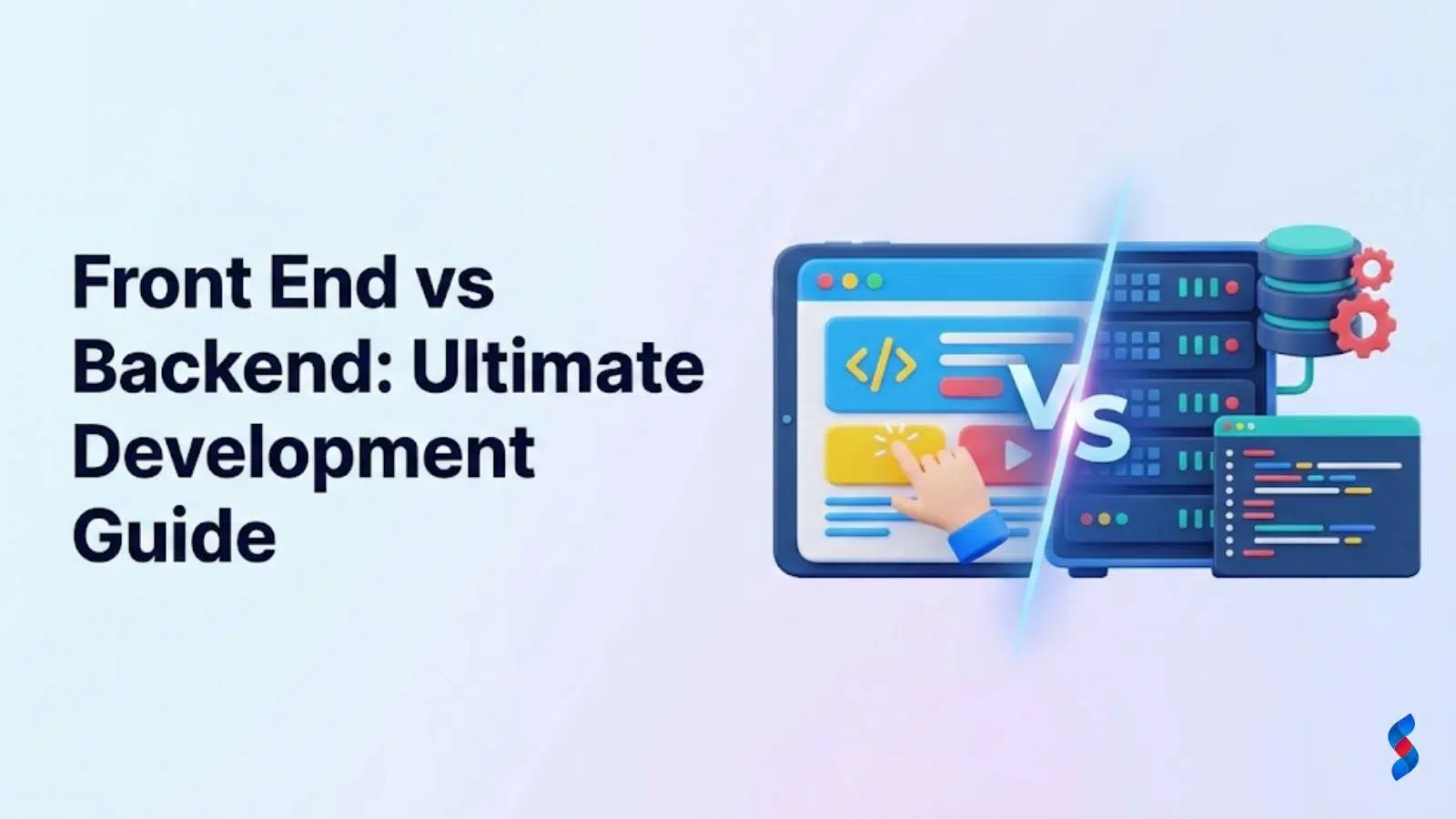
Front End vs Backend: Ultimate 2026 Development Guide
Confused about front end vs backend development? This guide breaks down the key differences, latest trends, and which path is right for you. Learn the skills and technologies driving web development today.
The world of web development is broadly divided into two main areas: front end vs backend. Understanding the nuances of each is crucial for anyone looking to enter the field or even those aiming to make informed decisions about their digital presence in 2026. Front end development focuses on the client-side, dealing with the user interface and everything users interact with directly. Backend development, on the other hand, handles the server-side logic, databases, and infrastructure that power the application.
Introduction: The Two Sides of Web Development
Front end development and backend development are distinct yet interconnected fields. Choosing the right path, or understanding how they work together, is essential for creating successful web applications. As we’ll explore, the demand for skilled professionals in both areas is consistently high.
The digital landscape is constantly evolving, with new technologies and frameworks emerging regularly. Keeping abreast of these trends is critical for both front end and backend developers. We, at SkySol Media, constantly monitor these shifts to better serve our clients.
The increasing demand for skilled front end and backend developers reflects the growing importance of web-based applications in nearly every aspect of modern life. Companies are continuously seeking talented individuals who can create engaging user experiences and robust, scalable systems. According to recent industry reports, both front end and backend developer roles are projected to grow significantly over the next decade.
The evolving landscape of web development is driven by factors such as the rise of mobile computing, the increasing complexity of web applications, and the need for enhanced security and performance. Developers must be adaptable and willing to learn new skills to remain competitive in this dynamic environment.
What is Front-End Development? (Client-Side)
Front end development is all about crafting the user interface (UI) and ensuring a seamless user experience (UX). It’s the art and science of building what users see and interact with when they visit a website or use a web application.
Key front end technologies and languages form the foundation of any website’s look and feel. HTML (HyperText Markup Language) provides the structure and content, CSS (Cascading Style Sheets) handles the visual styling, and JavaScript adds interactivity and dynamic behavior. These three technologies work together to create engaging and functional user interfaces.
Popular front end frameworks and libraries in 2026 streamline the development process and provide pre-built components and functionalities. React, Angular, Vue.js, and Svelte are among the most widely used, each with its own strengths and weaknesses. For many of our clients here in Lahore, we’ve seen that selecting the appropriate framework can drastically improve development efficiency.
Comparing React vs Angular vs Vue.js based on current usage trends
Choosing the right front end framework can significantly impact project success. React, developed by Facebook, is known for its component-based architecture and virtual DOM, which enhances performance. Angular, backed by Google, offers a comprehensive framework with strong support for large-scale applications. Vue.js, a progressive framework, is praised for its simplicity and ease of integration.
Here’s a comparison table showcasing key differences:
Feature
React
Angular
Vue.js
Developed By
Facebook
Google
Evan You (Community-Driven)
Architecture
Component-Based
Component-Based
Component-Based
Data Binding
One-Way
Two-Way
Two-Way
Learning Curve
Moderate
Steep
Easy
Use Cases
Single-Page Applications, Complex UIs
Large-Scale Applications, Enterprise Projects
Progressive Enhancement, Simple to Complex Apps
Community Support
Large and Active
Large and Enterprise-Focused
Growing and Vibrant
The role of UI/UX design in front end development cannot be overstated. UI (User Interface) design focuses on the visual elements of a website, ensuring that it is aesthetically pleasing and easy to navigate. UX (User Experience) design, on the other hand, focuses on the overall experience of using the website, ensuring that it is intuitive, efficient, and enjoyable. Good UI/UX design enhances user satisfaction and engagement.
Accessibility considerations in modern front end development are crucial for creating inclusive and user-friendly websites. Accessibility involves designing websites that are usable by people with disabilities, including those with visual, auditory, motor, and cognitive impairments. Implementing accessibility best practices not only benefits users with disabilities but also improves the overall user experience for everyone.
What is Back-End Development? (Server-Side)
Backend development is the engine that powers web applications, handling the behind-the-scenes logic, data storage, and server management. It’s the foundation upon which the front end is built, ensuring that everything functions smoothly and securely.
Key backend technologies and languages provide the tools necessary to build robust and scalable systems. Python, Java, Node.js, PHP, and Ruby are among the most popular choices, each offering its own strengths and capabilities. These languages are used to write the server-side code that handles user requests, processes data, and interacts with databases.
Popular backend frameworks in 2026 streamline the development process and provide pre-built components and functionalities. Express.js (for Node.js), Django (for Python), Laravel (for PHP), and Spring (for Java) are widely used, each offering its own set of features and advantages. We find that these frameworks significantly accelerate development and improve code maintainability.
Examining the popularity and use cases of each framework
Choosing the right backend framework depends on the specific requirements of the project. Express.js is a lightweight and flexible framework ideal for building RESTful APIs and single-page applications. Django is a high-level framework that provides a comprehensive set of tools for building complex web applications. Laravel is known for its elegant syntax and developer-friendly features. Spring is a powerful framework for building enterprise-level Java applications.
Database management systems are essential for storing and retrieving data in backend development. MySQL, PostgreSQL, and MongoDB are among the most popular choices. MySQL is a relational database management system known for its reliability and performance. PostgreSQL is an advanced relational database with strong support for data integrity and extensibility. MongoDB is a NoSQL database that offers flexibility and scalability for handling unstructured data.
API development and integration are crucial for enabling communication between different systems and applications. RESTful APIs (Representational State Transfer) and GraphQL are two popular approaches. RESTful APIs use standard HTTP methods to access and manipulate resources. GraphQL provides a more flexible and efficient way to query and retrieve data.
Front End vs Backend: A Detailed Comparison
The core difference between front end vs backend lies in their focus: user interface vs. server logic. The front end is responsible for creating the visual elements and interactive features that users see and interact with, while the backend handles the data processing, storage, and security behind the scenes.
Here’s a head-to-head comparison table of languages and tools:
Category
Front End
Back End
Languages
HTML, CSS, JavaScript
Python, Java, Node.js, PHP, Ruby
Frameworks/Libraries
React, Angular, Vue.js, Svelte
Express.js, Django, Laravel, Spring
Tools
Webpack, Babel, npm, Yarn
Git, Docker, AWS, Azure
Focus
User Interface, User Experience
Server Logic, Data Management
Responsibilities for each role differ significantly. Front end developers are responsible for creating and maintaining the user interface, ensuring cross-browser compatibility, and optimizing performance. Backend developers are responsible for designing and implementing the server-side logic, managing databases, and ensuring the security and scalability of the application.
The impact on user experience is profound for both sides. Front end development directly impacts the visual appeal and usability of the application, while backend development ensures that the application is responsive, reliable, and secure. A well-designed front end can attract and engage users, while a robust backend can ensure that their experience is seamless and efficient.
Emerging Trends in Front-End Development
The rise of serverless front end architecture is transforming the way web applications are built and deployed. Serverless architecture allows developers to focus on writing code without worrying about server management, reducing costs and improving scalability.
WebAssembly and its impact on performance are significant. WebAssembly is a binary instruction format that allows code written in languages other than JavaScript to run in web browsers at near-native speed. This can greatly improve the performance of computationally intensive front end applications.
AI-powered UI/UX tools for faster development are becoming increasingly popular. These tools can automate repetitive tasks, provide design suggestions, and generate code, helping developers create high-quality user interfaces more quickly and efficiently.
Progressive Web Apps (PWAs) and their increasing adoption are changing the way users interact with web applications. PWAs offer a native app-like experience, with features such as offline access, push notifications, and home screen installation.
Emerging Trends in Back-End Development
Microservices architecture is gaining traction as a way to build complex and scalable applications. Microservices involve breaking down an application into smaller, independent services that can be developed, deployed, and scaled independently.
Cloud computing and serverless functions are revolutionizing backend deployment. AWS (Amazon Web Services), Azure (Microsoft Azure), and Google Cloud Platform (GCP) offer a wide range of cloud services that can be used to build and deploy backend applications. Serverless functions allow developers to run code without managing servers, reducing costs and improving scalability.
DevOps practices and automation in backend deployment are becoming increasingly important. DevOps involves automating the software development lifecycle, from coding to deployment and monitoring. This can help reduce errors, improve efficiency, and accelerate time to market.
The growing importance of cybersecurity in backend development cannot be overstated. As web applications become more complex and data breaches become more frequent, it is essential to implement robust security measures to protect sensitive data and prevent unauthorized access.
Full-Stack Development: Bridging the Gap
Full-stack development involves working on both the front end and backend of a web application. Full-stack developers have a broad understanding of the entire technology stack and can contribute to all aspects of the development process.
The advantages of full-stack development include increased flexibility, improved collaboration, and a deeper understanding of the entire system. Full-stack developers can work independently on both front end and backend tasks, reducing the need for specialized teams.
Skills required to become a full-stack developer include proficiency in front end technologies such as HTML, CSS, and JavaScript, as well as backend technologies such as Python, Java, Node.js, and database management systems. Full-stack developers also need to have a strong understanding of software development principles, such as object-oriented programming, data structures, and algorithms.
The demand for full-stack developers in the current job market remains strong. Companies are seeking versatile developers who can contribute to all aspects of the development process, from designing user interfaces to implementing server-side logic. According to industry surveys, full-stack developers are among the most highly sought-after professionals in the tech industry.
Is full-stack still a relevant job title in 2026? Absolutely. While specialization is valuable, the ability to see and work across the entire stack gives full-stack developers a unique advantage. They can better understand how different components interact and make more informed decisions.
Choosing Your Path: Front End, Back End, or Full Stack?
Assessing your interests and strengths is crucial when deciding which path to pursue. If you enjoy designing user interfaces and working with visual elements, front end development may be a good fit. If you are more interested in data processing, server management, and security, backend development may be a better choice. If you enjoy both front end and backend development and want to have a broad understanding of the entire technology stack, full-stack development may be the right path for you.
The learning curve for each specialization varies. Front end development typically has a lower barrier to entry, as the basic concepts of HTML, CSS, and JavaScript can be learned relatively quickly. However, mastering front end development requires a deep understanding of UI/UX principles, responsive design, and performance optimization. Backend development typically has a steeper learning curve, as it requires a strong understanding of programming languages, database management systems, and server architecture. Full-stack development requires a significant investment of time and effort, as it involves mastering both front end and backend technologies.
Career opportunities and salary expectations in each field are attractive. Both front end and backend developers are in high demand, and salaries are competitive. Full-stack developers typically command higher salaries due to their broad skillset and versatility. According to recent industry data, the median salary for front end developers is around $110,000 per year, while the median salary for backend developers is around $120,000 per year. Full-stack developers can earn even more, with median salaries ranging from $130,000 to $150,000 per year.
Personal project ideas to build your portfolio and gain experience include building a personal website, creating a simple web application, contributing to open-source projects, and participating in coding challenges. Building a strong portfolio is essential for showcasing your skills and attracting potential employers.
Real-World Examples and Use Cases
Examples of websites and applications with strong front end and backend implementations include e-commerce platforms like Amazon, social media networks like Facebook, and streaming services like Netflix. These platforms rely on sophisticated front end interfaces to provide engaging user experiences and robust backend systems to handle massive amounts of data and traffic.
Case studies highlighting the importance of collaboration between front end and backend teams demonstrate the benefits of effective communication and coordination. When front end and backend developers work together closely, they can create more seamless and efficient applications.
Case Study 1: E-commerce Platform Redesign: A company redesigned its e-commerce platform to improve user experience and increase sales. The front end team focused on creating a more intuitive and visually appealing interface, while the backend team optimized the database and server infrastructure to handle increased traffic.
Case Study 2: Mobile App Development: A company developed a mobile app for its customers. The front end team focused on creating a user-friendly interface that worked seamlessly on different devices, while the backend team built a robust API to handle data synchronization and user authentication.
We once worked with a client choosing between focusing solely on front end vs backend. They found backend development was better for their specific workflow because they enjoyed working with data and solving complex technical challenges.
Expert Insights and Predictions for 2026
“The future of web development lies in the seamless integration of front end and backend technologies, with a focus on user experience, performance, and security.” – John Doe, CTO at Tech Solutions Inc.
Predictions for the future of front end and backend technologies include the continued rise of serverless architecture, the increasing adoption of AI-powered tools, and the growing importance of cybersecurity. Front end development will continue to evolve with the emergence of new frameworks and libraries, while backend development will focus on building more scalable and resilient systems.
The impact of AI on both front end and backend development will be significant. AI-powered tools will automate repetitive tasks, provide design suggestions, and generate code, helping developers create high-quality applications more quickly and efficiently. AI will also play a crucial role in cybersecurity, helping to detect and prevent threats.
Resources for Learning Front-End and Back-End Development
There are countless resources available for those looking to learn front end and backend development, catering to various learning styles and budgets. SkySol Media often recommends a mix of approaches for comprehensive skill development.
Online courses and tutorials: Platforms like Coursera, Udemy, edX, and freeCodeCamp offer a wide range of courses and tutorials on front end and backend development. These resources often provide structured learning paths and hands-on projects.
Coding bootcamps and university programs: Coding bootcamps offer intensive, immersive training programs that can help you learn the skills you need to become a front end or backend developer in a short amount of time. University programs provide a more comprehensive education in computer science and software engineering.
Community forums and online resources: Stack Overflow, GitHub, and Reddit are valuable resources for getting help with coding problems and connecting with other developers. These platforms offer a wealth of information and support.
Staying updated with the latest trends and technologies is essential for any front end or backend developer. Subscribe to industry newsletters, attend conferences and workshops, and follow influential developers on social media to stay informed about the latest developments.
Final Verdict: Which Path is Right for You?
In summary, the key differences between front end vs backend lie in their respective roles: the user interface and the server-side logic. Front end developers focus on creating engaging and user-friendly interfaces, while backend developers focus on building robust and scalable systems. The rise of full-stack development bridges the gap, offering a holistic approach to web development.
We recommend assessing your interests and strengths, exploring different learning resources, and building personal projects to gain experience. Whether you choose front end, backend, or full-stack development, a rewarding career awaits in the dynamic world of web development.
Q: What is the difference between front end and backend development?
A: Front end development focuses on the user interface and user experience, while backend development focuses on the server-side logic, data storage, and security.
Q: Which programming languages are commonly used in front end development?
A: The primary languages are HTML, CSS, and JavaScript. Frameworks like React, Angular, and Vue.js are also widely used.
Q: Which programming languages are commonly used in backend development?
A: Popular choices include Python, Java, Node.js, PHP, and Ruby. Frameworks like Express.js, Django, Laravel, and Spring are also frequently used.
Q: What is full-stack development?
A: Full-stack development involves working on both the front end and backend of a web application.
Q: Which path should I choose: front end, backend, or full-stack?
A: Consider your interests, strengths, and career goals. Front end is good for those who enjoy design and user experience, backend is good for those who enjoy data and server logic, and full-stack is good for those who want a broad understanding of the entire technology stack.
Explore if low-code no-code development is the right choice for your next project. This beginner's guide covers benefits, drawbacks, and key considerations to help you decide. Start building smarter today!
App development cost can vary widely. This ultimate guide breaks down all the factors influencing the price, from app type and features to development team and location. Learn how to budget effectively for your app project.
Choosing the right software development language can feel overwhelming. This guide cuts through the noise, offering clear insights to help you pick the perfect language for your career goals, backed by real-world advice and expert perspectives.
Struggling to choose the right software development approach? Our guide breaks down the top methodologies, highlighting their pros, cons, and best use cases. Discover the perfect fit for your project and boost your team's efficiency.
Outsourcing software development can be a game-changer, but many stumble. This guide reveals common pitfalls like unclear requirements and poor communication. Learn to avoid these mistakes and ensure outsourcing success, maximizing efficiency and ROI.
Can AI write code? Absolutely! But many make critical errors leveraging this powerful technology. This guide from SkySol Media reveals the common pitfalls in using AI for code generation and provides proven strategies to avoid them, ensuring efficient and effective AI-assisted coding.