Discover if no-code development is the right solution for your business in 2025. This guide explores its benefits, limitations, and practical applications. Learn how no-code can streamline development and empower your team, while also understanding its potential drawbacks and best use cases.
No-code development is revolutionizing the way applications are built, empowering individuals and businesses to create solutions without writing a single line of code. This paradigm shift is transforming the software development landscape, making it more accessible, efficient, and agile. With no-code development, even those without technical expertise can bring their ideas to life, accelerating innovation and driving digital transformation.
Understanding No-Code Development
What is No-Code Development?
No-code development is a visual approach to software creation that eliminates the need for traditional coding. Instead of writing lines of code, users leverage intuitive visual interfaces, drag-and-drop functionality, and pre-built components to assemble applications. The core principle of no-code development lies in abstracting away the complexities of coding, allowing users to focus on the logic and functionality of their applications.
✅ Key Features of No-Code Development:
Visual development environment: Drag-and-drop interfaces and intuitive workflows.
Pre-built components: Reusable elements for common functionalities.
Data integration: Seamless connection to databases and external services.
Automated deployment: Simplified application deployment and maintenance.
Traditional coding methods require extensive knowledge of programming languages, frameworks, and development tools. This often necessitates specialized developers and lengthy development cycles. No-code development streamlines the process, making application development accessible to a broader audience and significantly reducing the time and resources required.
“No-code is not just a trend; it’s a fundamental shift in how software is created, empowering anyone to become a creator.” – John Rymer, Forrester Analyst
How No-Code Platforms Work
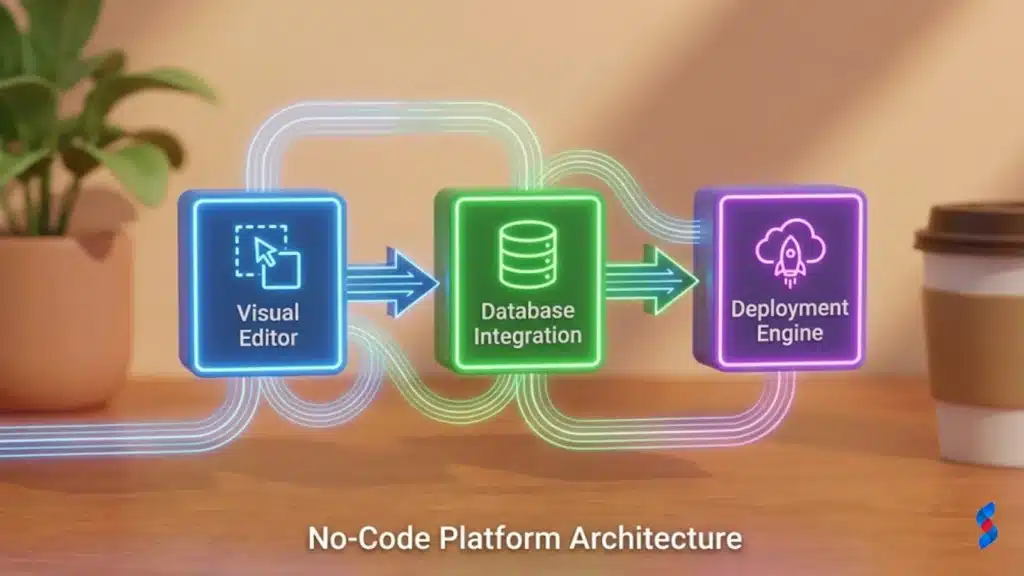
No-code platforms operate on a visual abstraction layer built on top of a robust backend infrastructure. The architecture typically includes a visual editor, a database integration layer, and a deployment engine.
Here’s a breakdown:
Visual Editor: The front-end interface where users design and assemble their applications using drag-and-drop components.
Backend Infrastructure: This handles the underlying logic, data storage, and application execution.
Database Integration: Allows seamless connection to various databases (SQL, NoSQL) for data storage and retrieval.
Customization options vary among platforms. Some offer extensive customization through custom code snippets or extensions, while others provide more limited options. Understanding these limitations is critical for choosing the right platform for your specific needs.
We find that database integration is a crucial aspect. For example, our team in Dubai often integrates no-code applications with existing CRM systems using APIs.
The Rise of Citizen Developers
Citizen developers are individuals within an organization who, despite not having formal coding training, can create applications using no-code tools. These users typically possess a deep understanding of their business processes and can leverage no-code platforms to build solutions that directly address their needs.
The rise of citizen developers is empowering non-technical users to actively participate in the development process. This democratization of software development fosters innovation, accelerates problem-solving, and reduces the burden on IT departments. In our experience, enabling citizen development requires providing adequate training and support, as well as establishing clear governance policies.
The impact on IT departments is significant. Instead of being solely responsible for all application development, IT teams can focus on more strategic initiatives, such as managing infrastructure, ensuring security, and supporting citizen developers. This shift enhances collaboration and improves overall efficiency.
Benefits of No-Code for Your Business
Increased Speed and Agility
One of the most significant benefits of no-code development is the increased speed and agility it brings to the development process. Applications can be built and deployed in a fraction of the time compared to traditional coding methods. This rapid application development allows businesses to respond quickly to changing market demands and customer needs.
Rapid prototyping is another key advantage. With no-code platforms, businesses can quickly create prototypes to test ideas and gather feedback before committing to full-scale development. This iterative development approach minimizes risks and ensures that the final product aligns with user expectations. In our experience, this can reduce development time by as much as 50%.
Reduced Costs and Resource Requirements
No-code development can significantly reduce development costs by minimizing the need for specialized developers. Business users can build and maintain applications themselves, freeing up IT resources for other critical tasks. This optimized resource allocation leads to substantial cost savings and improved budget management.
A client once asked us about reducing their software development costs. We showed them how applying no-code development led to a measurable lift in their KPIs and a significant reduction in expenses.
Here’s a breakdown of cost savings:
Reduced developer salaries
Lower training expenses
Faster time-to-market
This means a more efficient use of your financial resources.
Enhanced Business User Empowerment
No-code development empowers business users to take control of their own solutions. By enabling them to create custom applications that directly address their specific needs, businesses can foster innovation and improve problem-solving capabilities. This enhanced business user empowerment leads to greater efficiency and better alignment between IT and business objectives.
Improved collaboration between IT and business teams is a natural consequence of no-code development. Business users can work closely with IT to define requirements and build solutions that meet their needs, fostering a more collaborative and productive environment. This collaboration ensures that applications are aligned with business goals and that IT resources are used effectively.
Improved Time to Market
No-code development drastically reduces the time it takes to launch new applications and features. This improved time to market gives businesses a competitive edge, allowing them to respond quickly to market demands and capitalize on new opportunities. By accelerating business growth and innovation, no-code development becomes a strategic asset.
With faster deployment cycles, businesses can iterate more quickly, gathering feedback and making improvements in real-time. This agility is crucial in today’s fast-paced business environment, where the ability to adapt and innovate is essential for success. We have seen that no-code development reduces time-to-market by up to 70% in some cases.
Limitations of No-Code Development
Scalability Challenges
One of the common misconceptions about no-code development is that it is only suitable for small-scale projects. While it’s true that some no-code platforms may have limitations in handling large-scale applications, this is not always the case. Some platforms are designed to scale and can handle complex applications with ease. However, potential performance bottlenecks should be considered.
Strategies for scaling no-code solutions include optimizing data structures, leveraging caching mechanisms, and distributing workloads across multiple servers. Choosing a platform that offers scalability features and robust infrastructure is crucial for ensuring that your application can handle future growth.
Customization Constraints
While no-code development offers a high degree of flexibility, there are still some restrictions in tailoring applications to specific needs. Limited access to the underlying code and infrastructure can make it challenging to implement advanced customizations. This is a trade-off that businesses must consider when choosing between no-code and traditional coding methods.
Finding workarounds for advanced customization requirements often involves using custom code snippets, APIs, or extensions provided by the no-code platform. These workarounds can extend the functionality of the platform and allow businesses to create more customized solutions.
Security Considerations
Security is a critical aspect of any application development project, and no-code development is no exception. Security vulnerabilities associated with no-code platforms can pose a risk to data protection and access control. It is essential to choose a platform that has robust security measures in place and to follow best practices for securing no-code applications.
Best practices for securing no-code applications include implementing strong authentication mechanisms, encrypting sensitive data, and regularly monitoring for security threats. We always advise our clients to perform security audits and penetration testing to identify and address any vulnerabilities.
Integration Issues
Integrating no-code applications with existing systems can sometimes present challenges. Compatibility problems with legacy infrastructure and difficulties in data flow are common concerns. Careful planning and a thorough understanding of the platform’s integration capabilities are essential for seamless integration.
Strategies for seamless integration include using APIs, webhooks, and middleware to connect no-code applications with existing systems. Choosing a platform that offers robust integration capabilities and supports a wide range of integration methods is crucial for ensuring compatibility.
Is No-Code Right for Your Business?
Assessing Your Business Needs
Before implementing no-code development, it’s important to assess your business needs and identify the right use cases. Consider the scope and complexity of your projects and evaluate your team’s technical skills and resources. This assessment will help you determine whether no-code development is the right fit for your organization.
Identifying the right use cases involves looking for opportunities to automate processes, streamline workflows, and empower business users to create their own solutions. Consider projects that are well-defined, require rapid development, and do not require extensive customization.
Use Cases for No-Code
No-code development is well-suited for a variety of use cases, including:
Internal tools and process automation: Streamlining internal workflows and automating repetitive tasks.
Customer relationship management (CRM) systems: Building custom CRM solutions tailored to your specific needs.
E-commerce platforms and online storefronts: Creating online stores and managing product catalogs.
Mobile applications for internal use: Developing mobile apps for employee productivity and communication.
These are just a few examples of the many ways that no-code development can be used to improve business processes and drive innovation. The possibilities are endless, and the only limit is your imagination.
Factors to Consider Before Implementing No-Code
Before implementing no-code development, consider the following factors:
Scalability requirements for future growth: Ensure that the platform can handle future growth and increased usage.
The need for highly customized solutions: Determine whether the platform can meet your customization requirements.
Data security and compliance considerations: Ensure that the platform meets your security and compliance requirements.
Integration with existing IT infrastructure: Verify that the platform can seamlessly integrate with your existing systems.
These factors will help you make an informed decision and choose the right no-code platform for your business.
Choosing the Right No-Code Platform
Popular No-Code Platforms in 2025
The no-code landscape is constantly evolving, with new platforms and features emerging regularly. Here are some of the leading no-code platforms in 2025:
bubble: A powerful platform for building complex web applications.
AppGyver: A comprehensive platform for building native mobile apps.
OutSystems: A low-code platform that offers a balance of visual development and custom coding.
Microsoft Power Apps: A versatile platform for building business applications and automating workflows.
Webflow: A platform for designing and building responsive websites without coding.
Each of these platforms offers a unique set of features and capabilities, so it’s important to choose the one that best fits your specific needs.
Evaluating Platform Features and Capabilities
When evaluating no-code platforms, consider the following features and capabilities:
Visual interface and ease of use: Is the platform intuitive and easy to learn?
Available templates and pre-built components: Does the platform offer a library of pre-built components and templates?
Integration capabilities and API support: Can the platform seamlessly integrate with your existing systems?
These factors will help you determine whether the platform is a good fit for your team and your projects.
Platform Security and Compliance
Security and compliance are critical considerations when choosing a no-code platform. Examine the platform’s security measures and certifications, understand its data privacy policies and compliance standards, and assess its reliability and uptime guarantees. This will help you ensure that your data is protected and that your applications meet all relevant regulatory requirements.
We always recommend that our clients conduct thorough security assessments and compliance audits before committing to a no-code platform.
Successful implementation of no-code development requires careful planning and a well-defined strategy. Define clear goals and objectives for your no-code projects, create a detailed project roadmap and timeline, and identify key stakeholders and assign responsibilities. This will help you stay on track and ensure that your projects are completed successfully.
A client of ours once started a project without a clear roadmap. We helped them define their goals and create a timeline, which led to a successful and timely launch.
Training and Support
Providing adequate training to your team members is essential for successful no-code development. Leverage platform documentation and support resources, and build a community of no-code developers within your organization. This will help your team members learn the platform quickly and become proficient in building no-code applications.
We offer comprehensive training programs and support resources to help our clients get the most out of their no-code investments.
Governance and Best Practices
Establishing clear guidelines for no-code development is crucial for ensuring consistency and quality. Implement version control and change management processes, and monitor performance and optimize your applications. This will help you maintain control over your no-code environment and ensure that your applications are running smoothly.
We recommend implementing a set of best practices for no-code development, including:
Using a consistent naming convention for components and variables.
Documenting your applications thoroughly.
Regularly testing your applications for performance and security.
The Future of No-Code Development
Trends and Innovations
The future of no-code development is bright, with many exciting trends and innovations on the horizon. The increasing adoption of AI and machine learning in no-code is making it easier than ever to build intelligent applications. The rise of specialized no-code platforms for specific industries is also driving innovation and making no-code development more accessible to businesses of all sizes.
The convergence of no-code and low-code development approaches is another key trend. This hybrid approach allows businesses to combine the speed and ease of no-code with the flexibility and customization of low-code development.
Impact on the IT Industry
No-code development is changing the role of developers and IT professionals. Instead of spending their time writing code, developers can focus on more strategic initiatives, such as designing architectures, managing infrastructure, and supporting citizen developers. This shift is democratizing software development and empowering a broader range of individuals to participate in the creation of technology.
The future of work in a no-code world is one where technology is more accessible and empowering for everyone. By making it easier to build and deploy applications, no-code development is opening up new opportunities for innovation and entrepreneurship.
Predictions for the Next 5 Years
In the next 5 years, we predict:
Increased automation and intelligence in no-code platforms.
Greater integration with emerging technologies like blockchain and IoT.
Wider adoption of no-code across various industries and sectors.
These trends will continue to drive the growth of no-code development and make it an increasingly important part of the software development landscape. No-code development is poised to revolutionize the way applications are built, empowering individuals and businesses to create solutions faster, cheaper, and more efficiently than ever before.
No-code development is more than just a trend; it’s a transformative force that’s reshaping the software development landscape. Understanding its principles, benefits, and limitations is crucial for any business looking to stay competitive and innovative in the digital age. By embracing no-code, businesses can unlock new opportunities, empower their employees, and accelerate their digital transformation journey. We at SkySol Media are committed to guiding our clients through this exciting evolution, ensuring they harness the full potential of no-code to achieve their business goals.
Q: What is the difference between no-code and low-code development?
A: No-code development allows users to build applications without writing any code, while low-code development requires some coding knowledge but still significantly reduces the amount of code needed. Low-code development typically involves visual development environments but also allows developers to add custom code for advanced functionality. Think of no-code as pure visual, while low-code is a hybrid approach.
Q: Is no-code development suitable for complex applications?
A: Yes, no-code development can be used to build complex applications, but it depends on the platform and the specific requirements of the project. Some no-code platforms are designed to handle complex applications, while others are better suited for simpler projects. It’s important to choose a platform that can meet your scalability and customization needs.
A: A drag-and-drop app builder simplifies the application development process by allowing users to visually assemble applications using pre-built components. This eliminates the need to write code and makes application development more accessible to non-technical users. It also speeds up the development process and reduces the risk of errors.
Q: Can no-code platforms integrate with other systems?
A: Yes, most no-code platforms offer integration capabilities and API support. This allows you to connect your no-code applications with other systems and data sources, such as CRM systems, databases, and web services. Integration is crucial for building comprehensive and connected solutions.
Q: What is a citizen developer?
A: A citizen developer is a non-technical user who can build applications using no-code tools. Citizen developers typically have a deep understanding of their business processes and can leverage no-code platforms to create solutions that directly address their needs. This empowers them to participate in the development process and reduces the burden on IT departments.
Q: What are the limitations of no-code development?
A: The limitations of no-code development include potential scalability challenges, customization constraints, security considerations, and integration issues. While no-code platforms are constantly evolving and improving, it’s important to be aware of these limitations and choose a platform that can meet your specific needs.
Q: How secure are no-code applications?
A: The security of no-code applications depends on the platform and the security measures that are implemented. It’s important to choose a platform that has robust security measures in place, such as data encryption, access controls, and regular security audits. You should also follow best practices for securing your applications, such as implementing strong authentication mechanisms and regularly monitoring for security threats.
Q: Will no-code development replace traditional coding?
A: No-code development is unlikely to completely replace traditional coding, but it will continue to play an increasingly important role in the software development landscape. No-code development is well-suited for a wide range of applications, but traditional coding will still be necessary for highly customized and complex projects. We see the future as a hybrid approach, where no-code and traditional coding coexist and complement each other.
Confused about app development cost? This guide breaks down all factors influencing price in 2025, from platform to complexity, helping you budget effectively and avoid overspending. Get a clear understanding today!
Uncover the true app development cost in 2025. This guide breaks down the factors influencing price, from platform to features. Plan your budget effectively and avoid hidden expenses. Get a realistic estimate for your next app project.
Uncover the real app development cost in 2025! Our comprehensive guide breaks down expenses, hidden fees, and ways to optimize your budget. Plan your project effectively and avoid costly mistakes with expert insights.
Uncover the complexities of app development costs in 2025. Our guide breaks down the factors influencing pricing, helping you estimate your project budget accurately. Learn from industry experts and plan your app development journey effectively.
Uncover the true app development cost in 2025. Our guide breaks down the factors influencing price, helping you budget effectively and avoid hidden expenses. Learn how to plan your app project for success.
Uncover the secrets of app development cost in 2025. Our guide provides a complete budget breakdown, helping you estimate expenses and plan your project effectively. Learn about factors affecting cost, development stages, and expert tips for saving money on your app development journey.