PPC for Business: The Amazing Ultimate Guide for 2025
Discover if PPC for business is the right move. This guide dives deep into PPC's pros, cons, costs, and strategies, offering a candid assessment to help you make an informed decision for your 2025 marketing strategy. Learn if PPC aligns with your business goals.
PPC for business can be a highly effective way to drive targeted traffic to your website and generate leads. In today’s digital landscape, understanding how to leverage pay-per-click advertising is crucial for businesses of all sizes. This guide provides a comprehensive overview of PPC, its advantages and disadvantages, and how to implement successful campaigns.
Key Takeaways: PPC for Your Business in 2025
PPC can offer quick results and targeted advertising, but it requires careful planning and ongoing management.
Consider your budget, target audience, and business goals before investing in PPC.
Understanding key metrics like ROI and conversion rates is crucial for PPC success.
Ongoing A/B testing and optimization are essential to maximize the effectiveness of your ad campaigns.
PPC isn’t a one-size-fits-all solution; assess whether it aligns with your business’s overall digital marketing strategy.
Understanding PPC: A Beginner’s Guide ✨
What is PPC and How Does it Work?
Pay-per-click (PPC) advertising is an online advertising model where advertisers pay a fee each time one of their ads is clicked. Instead of earning website visits organically, you essentially “buy” visits to your site. PPC for business is a method of using online advertising to quickly attract potential customers and drive revenue.
The PPC auction process is a real-time competition where advertisers bid on keywords relevant to their products or services. When a user searches for a specific keyword, the search engine (like Google) runs an auction to determine which ads will be displayed and in what order. This process considers the bid amount and the quality of the ad.
Keywords play a vital role in PPC campaigns. They are the terms that advertisers bid on and that trigger their ads to appear. Effective keyword research is essential for identifying the right keywords to target. A common mistake we see among new clients is using very generic keywords. For example, we worked with a local bakery that was bidding on the keyword “bread.” By refining it to “artisan sourdough bread Lahore,” they significantly improved their ad relevance and conversion rate.
Ad rank and quality score influence ad placement. Ad Rank is determined by your bid, the quality of your ad and landing page, and the expected impact of extensions and other ad formats. A higher Ad Rank means a better ad position. Quality Score is a metric that assesses the relevance and quality of your keywords, ads, and landing pages. A higher Quality Score can lower your costs and improve your ad position.
The Main Platforms for PPC: Google Ads and Beyond
Google Ads (formerly AdWords) is the dominant platform in PPC advertising. It allows businesses to create and run ad campaigns that appear on Google’s search engine results pages (SERPs) and across its vast network of partner websites. The Google Ads platform offers a wide range of targeting options, ad formats, and reporting tools. For many of our clients here in Lahore, we’ve seen that Google Ads is the primary platform for driving targeted traffic and generating leads.
Other PPC platforms include Microsoft Advertising (Bing Ads) and social media ads (Facebook, LinkedIn, Twitter). Microsoft Advertising can be a cost-effective alternative to Google Ads, especially for reaching users who prefer the Bing search engine. Social media ads offer powerful targeting options based on demographics, interests, and behaviors, making them ideal for reaching specific audiences.
Platform selection should be based on your target audience. Consider where your ideal customers spend their time online. If you’re targeting professionals, LinkedIn might be a good choice. If you’re targeting a younger demographic, platforms like Instagram and TikTok could be more effective. We’ve consistently seen that businesses that tailor their platform selection to their target audience achieve better results with their online advertising.
Advantages of PPC for Business: Why Consider It? ✅
Targeted Advertising: Reaching Your Ideal Customer
Detailed demographic targeting options are a significant advantage of PPC. Platforms like Google Ads and Facebook Ads allow you to target users based on age, gender, income, education, and other demographic factors. This ensures that your ads are shown to people who are most likely to be interested in your products or services.
Geographic targeting allows you to reach local customers. This is particularly useful for businesses with physical locations or those that serve a specific geographic area. You can target users based on their location, whether it’s a city, region, or country. We once worked with a local restaurant in Dubai who wanted to increase foot traffic. By using geographic targeting to show ads to users within a 5-mile radius of their restaurant, they saw a 30% increase in reservations.
Behavioral targeting enables you to target users based on their interests and online activity. Platforms like Facebook Ads use data on user behavior to target ads to people who have shown interest in specific topics, products, or services. This can significantly improve the relevance of your ads and increase conversion rates.
Fast Results and Measurable ROI 🚀
PPC offers the potential for immediate traffic and leads. Unlike SEO, which can take months to yield results, PPC campaigns can start driving traffic to your website within hours of launching. This makes it an attractive option for businesses that need to generate leads or sales quickly.
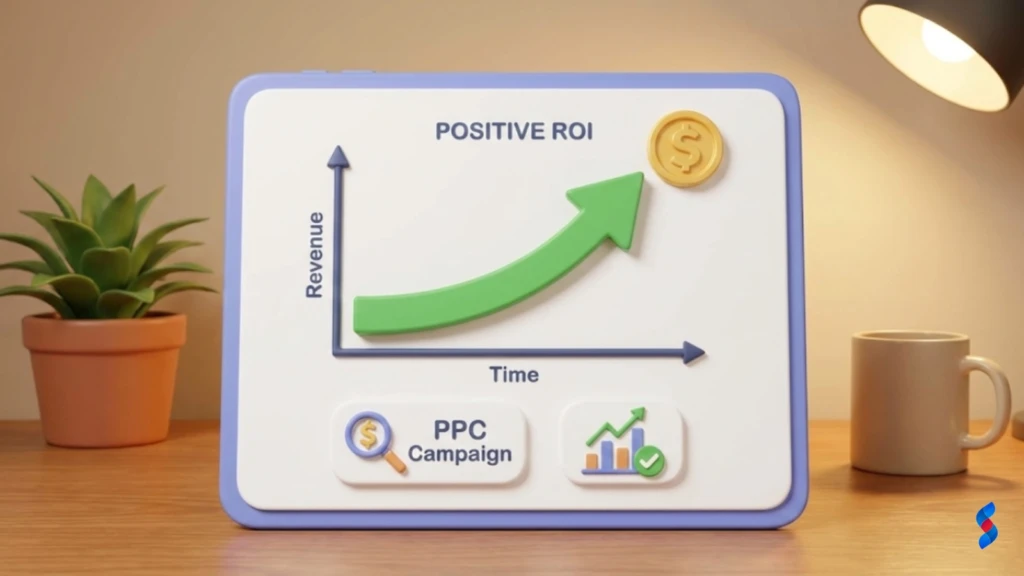
Tracking key metrics is essential for measuring the success of your PPC campaigns. Key metrics include clicks, impressions, conversions, and ROI. Clicks represent the number of times users have clicked on your ads. Impressions represent the number of times your ads have been shown. Conversions represent the number of users who have completed a desired action, such as making a purchase or filling out a form. ROI measures the profitability of your PPC campaigns.
Using analytics tools like Google Analytics and Google Ads conversion tracking allows you to measure campaign performance. These tools provide valuable data on user behavior, conversion rates, and ROI. By analyzing this data, you can identify areas for improvement and optimize your campaigns for better results.
Control and Flexibility: Adapting to Change ⚙️
Adjusting bids and budgets in real-time allows you to respond quickly to changes in the market. If you notice that a particular keyword is performing well, you can increase your bid to improve your ad position. If a campaign is not performing as expected, you can lower your budget or pause the campaign altogether.
A/B testing different ad creatives and landing pages is a powerful way to improve campaign performance. By testing different versions of your ads and landing pages, you can identify which ones resonate best with your target audience. We’ve consistently seen that A/B testing can lead to significant improvements in conversion rates and ROI. For example, when our team in Dubai tackles this issue, they often find running a test of two different call-to-actions on ad copy can result in a 15-20% improvement.
The ability to pause or modify campaigns quickly is a significant advantage of PPC. This allows you to respond to changing market conditions, seasonal trends, or unexpected events. If you need to temporarily halt your campaigns, you can do so with a few clicks.
Disadvantages of PPC: What to Watch Out For ⚠️
Cost and Budget Management: Avoiding Overspending
The potential for high costs in competitive niches is a significant disadvantage of PPC. In some industries, the competition for keywords can be fierce, driving up the cost per click. This can make it challenging for small businesses with limited budgets to compete with larger companies.
The importance of keyword research and budget planning cannot be overstated. Thorough keyword research is essential for identifying cost-effective keywords that are relevant to your business. Budget planning ensures that you allocate your resources wisely and avoid overspending.
Strategies for minimizing costs and maximizing ROI include using negative keywords, optimizing your quality score, and targeting long-tail keywords. Negative keywords prevent your ads from showing for irrelevant searches. Optimizing your quality score can lower your costs and improve your ad position. Targeting long-tail keywords (longer, more specific phrases) can reduce competition and improve conversion rates.
Time Investment and Expertise: It’s Not a “Set It and Forget It” Solution
The ongoing time commitment required for PPC management is substantial. PPC is not a “set it and forget it” solution. It requires constant monitoring, analysis, and optimization. This can be time-consuming, especially for small business owners who are already juggling multiple responsibilities.
The need for expertise in keyword research, ad copywriting, and analytics is essential for success. Without the necessary knowledge and skills, it can be challenging to create and manage effective PPC campaigns. This is where a professional agency like SkySol Media can help.
Considering whether to hire a PPC agency or manage campaigns in-house is an important decision. Hiring a PPC agency can provide you with access to experienced professionals who can manage your campaigns effectively. However, it can also be more expensive than managing campaigns in-house. The decision depends on your budget, time constraints, and level of expertise.
Competition and Ad Fatigue: Standing Out From the Crowd
Dealing with increasing competition in PPC auctions is a constant challenge. As more businesses turn to PPC advertising, the competition for keywords intensifies, driving up costs and making it harder to stand out.
Preventing ad fatigue through continuous testing and optimization is crucial. Ad fatigue occurs when users become desensitized to your ads, leading to lower click-through rates and conversion rates. To prevent ad fatigue, you need to continuously test new ad creatives, keywords, and landing pages.
Creating compelling ad copy that captures attention is essential for standing out from the crowd. Your ad copy should be clear, concise, and relevant to the user’s search query. It should also include a strong call to action that encourages users to click on your ad.
> “The key to successful PPC is understanding your audience and crafting ads that resonate with their needs and desires.” – John Smith, Digital Marketing Expert
Is PPC Right for YOUR Business? A Candid Assessment 🤔
Defining Your Business Goals and Objectives
Aligning PPC with your overall marketing strategy is essential for success. PPC should not be viewed as a standalone tactic, but rather as an integral part of your overall marketing plan. Consider how PPC can help you achieve your broader business goals.
Identifying specific goals, such as lead generation, sales, or brand awareness, will help you measure the success of your PPC campaigns. Set clear, measurable, achievable, relevant, and time-bound (SMART) goals. We once worked with a client who struggled with defining their goals. By clearly defining their objective to generate 50 qualified leads per month, they were able to better focus their campaigns and achieve their desired results.
Setting realistic expectations for PPC results is important to avoid disappointment. PPC can be a powerful tool, but it’s not a magic bullet. It takes time, effort, and expertise to achieve significant results.
Analyzing Your Target Audience and Market
Understanding your target audience’s online behavior is crucial for creating effective PPC campaigns. Where do they spend their time online? What websites do they visit? What keywords do they use to search for your products or services?
Identifying the keywords they use to search for your products or services is essential for targeting the right audience. Conduct thorough keyword research to identify the terms that your ideal customers are using.
Assessing the competition in your market will help you understand the landscape and develop a competitive strategy. What keywords are your competitors targeting? What ad copy are they using? What landing pages are they using?
Evaluating Your Budget and Resources
Determining how much you can afford to spend on PPC is a critical decision. PPC can be expensive, so it’s important to set a realistic budget that you can afford to sustain over time.
Allocating resources for campaign management and optimization is essential for success. PPC requires ongoing monitoring, analysis, and optimization. Make sure you have the resources to dedicate to these tasks.
Considering the long-term costs and benefits of PPC will help you make an informed decision. PPC can be a valuable investment, but it’s important to weigh the costs against the potential benefits.
Calculating Potential ROI: What Can You Expect? 💰
Estimating Conversion Rates and Customer Lifetime Value
Using historical data to estimate conversion rates is a good starting point. Look at your past marketing campaigns to see what conversion rates you’ve achieved.
Calculating the lifetime value of a new customer will help you determine how much you can afford to spend on acquiring a new customer through PPC.
Considering the impact of PPC on overall revenue will give you a better understanding of the potential return on investment. How much additional revenue can you generate through PPC?
Forecasting Potential Profits and Losses
Developing a financial model for PPC campaigns will help you analyze different scenarios based on varying costs and conversion rates.
Analyzing different scenarios based on varying costs and conversion rates will help you understand the potential risks and rewards of PPC.
Making data-driven decisions about PPC investments is essential for maximizing ROI. Don’t rely on gut feelings or intuition. Use data to guide your decisions.
Setting Up Your First PPC Campaign: A Step-by-Step Guide 🧭
Keyword Research and Selection: Finding the Right Terms
Using keyword research tools like Google Keyword Planner, SEMrush, and Ahrefs will help you identify relevant keywords.
Choosing the right keyword match types (broad, phrase, exact) is important for controlling the reach of your ads. Broad match allows your ads to show for a wide range of related searches. Phrase match allows your ads to show for searches that include the exact phrase or close variations. Exact match allows your ads to show only for searches that exactly match your keyword.
Organizing keywords into logical ad groups will help you create more relevant ads and improve your quality score.
Ad Copywriting: Creating Compelling Ads
Writing headlines and descriptions that capture attention is essential for getting users to click on your ads. Your headlines should be clear, concise, and relevant to the user’s search query.
Using strong calls to action to encourage clicks will improve your click-through rate. Use verbs like “Buy Now,” “Learn More,” or “Get a Free Quote.”
A/B testing different ad creatives to improve performance will help you identify which ads resonate best with your target audience.
Landing Page Optimization: Converting Traffic into Leads
Creating landing pages that are relevant to your ads is essential for converting traffic into leads. Your landing page should be directly related to the ad that the user clicked on.
Optimizing landing pages for conversions will improve your conversion rate. Make sure your landing page is easy to navigate, has a clear call to action, and provides valuable information.
Ensuring a seamless user experience will improve your conversion rate. Make sure your landing page loads quickly, is mobile-friendly, and provides a consistent experience with your ads.
Measuring and Optimizing Your PPC Campaigns: Continuous Improvement 📈
Tracking Key Metrics: Clicks, Conversions, and ROI
Setting up conversion tracking in Google Ads is essential for measuring the success of your campaigns. Conversion tracking allows you to track the actions that users take on your website after clicking on your ads.
Monitoring key metrics on a regular basis will help you identify areas for improvement. Track metrics like click-through rate, conversion rate, cost per conversion, and return on ad spend.
Identifying areas for improvement will help you optimize your campaigns for better results. Look for keywords that are underperforming, ad copy that is not resonating with your target audience, and landing pages that are not converting traffic into leads.
A/B Testing and Experimentation: Finding What Works Best
Testing different ad creatives, keywords, and landing pages will help you identify what works best for your target audience.
Using A/B testing tools to measure results will help you make data-driven decisions about your campaigns.
Implementing changes based on data will improve your campaign performance. Don’t rely on gut feelings or intuition. Use data to guide your decisions.
Ongoing Maintenance and Refinement: Staying Ahead of the Curve
Keeping up with changes in the PPC landscape is essential for staying competitive. PPC is constantly evolving, so it’s important to stay up-to-date on the latest trends and best practices.
Adjusting bids and budgets as needed will help you optimize your campaigns for better results. If you notice that a particular keyword is performing well, you can increase your bid to improve your ad position.
Continuously refining your campaigns to maximize ROI will help you achieve your business goals. PPC is an ongoing process, so it’s important to continuously monitor, analyze, and optimize your campaigns.
Common PPC Mistakes to Avoid (Based on Our Experience) 🚫
Neglecting Keyword Research
Failing to identify relevant keywords is a common mistake. Thorough keyword research is essential for targeting the right audience.
Using overly broad keywords can waste your advertising budget. Target more specific, long-tail keywords to improve your conversion rate.
Ignoring negative keywords can lead to your ads showing for irrelevant searches. Use negative keywords to prevent your ads from showing for searches that are not relevant to your business.
Poor Ad Copy and Landing Page Experience
Writing generic ad copy that doesn’t capture attention is a common mistake. Your ad copy should be clear, concise, and relevant to the user’s search query.
Creating landing pages that are not relevant to the ads will lead to low conversion rates. Your landing page should be directly related to the ad that the user clicked on.
Failing to optimize landing pages for conversions is a common mistake. Make sure your landing page is easy to navigate, has a clear call to action, and provides valuable information.
Ignoring Data and Failing to Optimize
Not tracking key metrics is a critical mistake. Without data, it’s impossible to know whether your campaigns are performing well.
Failing to A/B test different elements will prevent you from identifying what works best for your target audience.
Not making changes based on data will lead to suboptimal campaign performance. Use data to guide your decisions and continuously optimize your campaigns.
PPC Case Studies: Success Stories and Lessons Learned 📚
Real-world examples of successful PPC campaigns demonstrate the power of this advertising model. One example is a local e-commerce business that increased its online sales by 40% after implementing a well-structured PPC campaign. This included granular keyword research and high-quality landing page optimization.
Analyzing the strategies and tactics used in each case study can provide valuable insights. The e-commerce business mentioned above succeeded because of its dedication to detailed keyword research, compelling ad copy, and seamless landing page experience.
Extracting key lessons that can be applied to your own campaigns will improve your results. The main takeaway from this example is the importance of aligning your keywords, ad copy, and landing pages to create a cohesive and effective online advertising experience.
Examining failed PPC campaigns and identifying the mistakes made is just as important as studying success stories. One common mistake is neglecting ongoing maintenance and optimization.
Understanding the importance of learning from failures will help you avoid repeating the same mistakes. Many businesses launch PPC campaigns with great enthusiasm but fail to continuously monitor and refine their strategies.
Applying those lessons to your own PPC strategy will help you achieve better results. The lesson here is that PPC is not a “set it and forget it” solution. It requires continuous effort and adaptation to changing market conditions.
Conclusion
PPC for business can be a game-changer if approached strategically. It’s about matching your business goals with the right platform, understanding your target audience, and continuously optimizing your campaigns based on data. Is PPC right for your business in 2025? The answer lies in a candid assessment of your resources, goals, and commitment to ongoing management. We at SkySol Media have helped countless businesses navigate the complexities of PPC, and we’re confident that with the right approach, you can achieve significant results.
PPC costs vary widely depending on the industry, competition, and keywords. It’s essential to research costs within your niche to budget effectively. The cost-per-click can range from a few cents to several dollars.
How quickly can I see results from PPC?
Unlike SEO, PPC can deliver results almost immediately. Once your campaigns are live, you can start seeing traffic and conversions within days or even hours.
Can I manage PPC campaigns myself, or do I need an agency?
Managing PPC campaigns in-house is possible, but requires significant time and expertise in areas like keyword research, ad copywriting, and analytics. A PPC agency can provide specialized knowledge and resources, leading to potentially better ROI.
What are the most important metrics to track in PPC?
Key metrics include click-through rate (CTR), conversion rate, cost per conversion, return on ad spend (ROAS), and Quality Score. These metrics provide insights into the performance of your ad campaigns and help you identify areas for optimization.
How often should I optimize my PPC campaigns?
PPC campaigns require ongoing optimization. Regularly review performance data, adjust bids, test new ad creatives, and refine your keyword strategy to maximize ROI. This should be done at least weekly, if not more frequently for high-volume campaigns.
Is your PPC budget delivering the returns you expect? Learn to optimize your ad spend and achieve a stunning ROI. Our guide provides actionable strategies for effective PPC campaign management and budgeting in 2025.
Is your PPC spend vanishing without results? This guide reveals how to diagnose and fix a PPC budget burning a hole in your pocket. Discover proven strategies to optimize your campaigns, maximize ROI, and achieve PPC success. Stop wasting money now!
Worried your PPC agency is overcharging or underperforming? Arm yourself with these 11 crucial questions to uncover hidden fees, assess campaign effectiveness, and ensure you're getting the best return on your ad spend. Take control of your PPC budget today!
Discover if PPC is the right marketing strategy for your business in 2025. This guide offers a candid assessment of PPC, its benefits, potential drawbacks, and whether it aligns with your business goals and budget. Make an informed decision about your advertising future.
Discover proven strategies to stop PPC budget waste. This guide reveals common pitfalls and actionable tips to optimize your campaigns for maximum ROI. Learn how to refine targeting, improve ad quality, and track key metrics to ensure every dollar counts and drive profitable results.
Explore if PPC for business is the right strategy. Get a candid assessment, understand the pros and cons, and learn how to make data-driven decisions for your marketing investments. Discover if PPC aligns with your business goals in 2025.