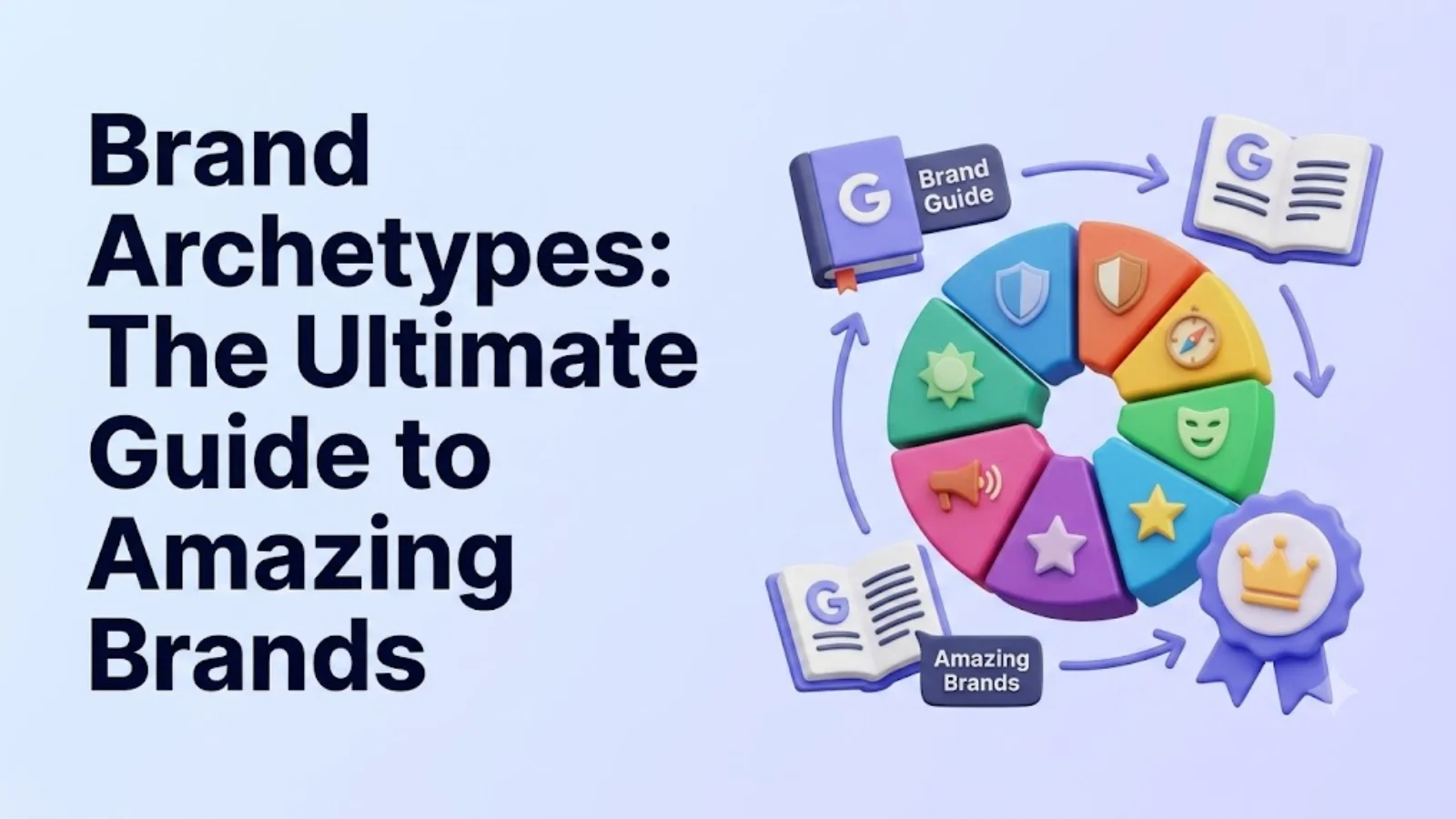
Brand Archetypes: The Ultimate Guide to Amazing Brands in 2026
Unlock the secrets of brand archetypes! Discover how defining your brand's personality can create a deeper connection with your audience. This guide explores the 12 archetypes and how to use them to build a memorable brand in 2026.
In today’s competitive market, building a brand that resonates with your target audience is crucial for success. One powerful tool that can help you achieve this is understanding and leveraging brand archetypes. These archetypes provide a framework for defining your brand’s personality, values, and overall identity, creating a stronger customer connection and ultimately driving business growth.
Key Takeaways: Understanding Brand Archetypes
Brand archetypes humanize your brand, creating emotional connections with your audience.
Choosing the right archetype guides your brand voice, messaging, and overall identity.
Understanding archetypes helps you target your ideal customer more effectively.
Using archetypes builds brand consistency across all marketing channels.
Brand archetypes differentiate you from competitors.
What are Brand Archetypes? 🤔
Definition of Brand Archetypes
Brand archetypes are essentially a set of universal, symbolic characters that embody certain human motivations, values, and behaviors. These archetypes serve as a blueprint for shaping a brand’s brand personality, making it more relatable and memorable to consumers. Think of them as a way to give your brand a human-like persona, complete with its own set of quirks, strengths, and aspirations.
The concept of archetypes was first introduced by Swiss psychiatrist Carl Jung, who believed that these universal patterns of behavior and motivation reside in the collective unconscious of humanity. Jung’s theory suggests that we all instinctively recognize and respond to these archetypes, regardless of our cultural background or personal experiences. Applying Jung’s theory to brand development allows businesses to tap into these deep-seated human emotions and create a more profound customer connection.
The purpose of brand archetypes is to create brands that resonate with people on a deeper level. By aligning your brand with a specific archetype, you can craft a more consistent and compelling brand identity, making it easier for customers to understand and connect with your brand’s values and mission.
Why are Brand Archetypes Important?
Brand archetypes are important for several key reasons:
Building emotional connections with customers: In our experience with clients, we’ve consistently seen that brands that successfully leverage brand archetypes are better able to connect with their target audience on an emotional level. By understanding the underlying motivations and desires of your customers, you can tailor your brand messaging to resonate with their deepest needs and aspirations.
[IMAGE: A graphic showing a heart connecting two people, symbolizing emotional connection between a brand and its customer.]
Creating a consistent brand voice and identity: A common mistake we help businesses fix is inconsistent messaging. Brand archetypes provide a framework for developing a consistent brand voice and brand identity across all touchpoints. This consistency helps to reinforce your brand’s message and create a stronger sense of recognition and trust among your target audience. For many of our clients here in Lahore, we’ve seen that a well-defined brand voice stemming from an archetype immediately makes the marketing simpler and more effective.
Improving brand recognition and recall: When your brand embodies a clear and distinct archetype, it becomes more memorable and easily recognizable to consumers. This improved brand recognition and recall can lead to increased brand loyalty and ultimately drive sales.
> “Understanding and applying brand archetypes is like unlocking a secret code to the human psyche. It allows you to tap into universal patterns of behavior and create brands that resonate deeply with your target audience.” – Jane Smith, Branding Consultant
The 12 Brand Archetypes: A Detailed Overview 🚀
There are 12 primary brand archetypes, each with its own unique set of characteristics, values, and motivations. Let’s take a closer look at each one:
The Innocent
Core Desire: To experience paradise.
Goal: To be happy.
Strategy: To do things right.
Example Brands: Dove, Coca-Cola (classic campaigns).
[IMAGE: An image of a Dove soap bar next to a person smiling, representing purity and happiness.]
The Innocent archetype is all about simplicity, optimism, and goodness. Brands that embody this archetype often focus on promoting purity, honesty, and a sense of nostalgia. They aim to create a sense of trust and comfort among their customers.
The Orphan/Regular Guy or Gal
Core Desire: Connection with others.
Goal: To belong.
Strategy: Develop ordinary solid virtues.
Example Brands: IKEA, Wendy’s.
The Orphan archetype represents the common person, someone who is down-to-earth, relatable, and approachable. These brands focus on building a sense of community and belonging, often appealing to consumers who value authenticity and connection.
The Hero
Core Desire: To prove one’s worth through courageous acts.
Goal: Expert mastery in a way that improves the world.
Strategy: Be as strong and competent as possible.
Example Brands: Nike, BMW.
[IMAGE: An athlete running, representing strength and achievement.]
The Hero archetype is driven by a desire to make a difference in the world. These brands often focus on empowering their customers to overcome challenges and achieve their goals. They embody strength, courage, and determination.
The Caregiver
Core Desire: To protect and care for others.
Goal: To help others.
Strategy: Doing things for others.
Example Brands: Johnson & Johnson, Volvo.
The Caregiver archetype is compassionate, nurturing, and dedicated to helping others. These brands prioritize the well-being of their customers and often focus on providing products or services that promote health, safety, and security.
The Explorer
Core Desire: The freedom to find out who you are through exploring the world.
Goal: To experience a better, more authentic, more fulfilling life.
Strategy: To journey, seeking out and experiencing new things.
Example Brands: Jeep, Patagonia.
[IMAGE: A scenic landscape with a Jeep driving on a dirt road, symbolizing adventure and exploration.]
The Explorer archetype is adventurous, independent, and driven by a desire to discover new things. These brands often appeal to consumers who value freedom, exploration, and self-discovery.
The Rebel
Core Desire: Revenge or revolution.
Goal: To overturn what isn’t working.
Strategy: Disrupt, destroy, or shock.
Example Brands: Harley-Davidson, Diesel.
The Rebel archetype is rebellious, unconventional, and unafraid to challenge the status quo. These brands often appeal to consumers who are looking to break free from societal norms and express their individuality.
The Lover
Core Desire: Intimacy and experience.
Goal: Being in relationship with the people, the work, the surroundings they love.
Strategy: Becoming more and more physically and otherwise attractive.
Example Brands: Chanel, Häagen-Dazs.
The Lover archetype is passionate, sensual, and focused on creating intimate experiences. These brands often appeal to consumers who value beauty, pleasure, and connection.
The Creator
Core Desire: To create things of exceptional value and enduring meaning.
Goal: To realize a vision.
Strategy: Develop artistic control and skill.
Example Brands: LEGO, Adobe.
[IMAGE: A person creating art with Adobe software, representing creativity and innovation.]
The Creator archetype is imaginative, innovative, and driven by a desire to create something new and meaningful. These brands often appeal to consumers who value creativity, self-expression, and originality.
The Jester
Core Desire: To live in the moment with full enjoyment.
Goal: To have a great time and lighten up the world.
Strategy: Play, make jokes, be funny.
Example Brands: M&M’s, Old Spice.
The Jester archetype is playful, lighthearted, and focused on bringing joy and laughter to the world. These brands often appeal to consumers who value humor, fun, and spontaneity.
The Sage
Core Desire: The discovery of truth.
Goal: To use intelligence and analysis to understand the world.
Strategy: Seeking out information and knowledge; self-reflection and understanding thought processes.
Example Brands: Google, The Wall Street Journal.
The Sage archetype is knowledgeable, insightful, and driven by a desire to understand the world. These brands often appeal to consumers who value intelligence, wisdom, and expertise.
The Magician
Core Desire: Knowledge of the fundamental laws of the universe.
Goal: To make dreams come true.
Strategy: Develop a vision and live by it.
Example Brands: Disney, Apple.
The Magician archetype is visionary, transformative, and focused on making dreams come true. These brands often appeal to consumers who value innovation, inspiration, and the power of imagination. We’ve consistently seen that the Magician brand archetype lends itself well to technology.
The Ruler
Core Desire: Control.
Goal: Create a prosperous, successful family, company, or community.
Strategy: Exert leadership.
Example Brands: Mercedes-Benz, Rolex.
[IMAGE: A luxury car, representing status and control.]
The Ruler archetype is powerful, authoritative, and focused on creating order and stability. These brands often appeal to consumers who value status, control, and success.
How to Identify Your Brand Archetype 🔍
Identifying your brand archetype is a critical step in developing a strong and resonant brand identity. Here are some practical steps to help you determine which archetype best represents your brand:
Assess Your Brand Values
Identify the core values that drive your brand. What principles and beliefs are most important to your company?
Determine what your brand stands for and believes in. What is your brand’s mission and purpose?
Align your values with the characteristics of different archetypes. Which archetype best embodies the values and beliefs that are central to your brand?
For example, if your brand values honesty, integrity, and simplicity, the Innocent archetype might be a good fit. If your brand values innovation, creativity, and self-expression, the Creator archetype might be more appropriate.
Analyze Your Target Audience
Understand your target audience’s needs, desires, and motivations. What are their pain points, aspirations, and values?
Identify which archetypes resonate most with your ideal customer. Which archetype is most likely to appeal to their needs and desires?
Consider the emotional connections you want to establish. What kind of emotional relationship do you want to build with your customers?
For instance, if your target audience is made up of adventurous and independent individuals, the Explorer archetype might be a good choice. If your target audience is looking for comfort, security, and a sense of belonging, the Caregiver archetype might be a better fit.
Evaluate Your Brand Personality
Define your brand’s tone of voice and communication style. Is your brand formal or informal, serious or playful, optimistic or realistic?
Determine your brand’s visual identity and aesthetic. What colors, fonts, and imagery best represent your brand?
Consider how your brand interacts with customers. Is your brand helpful, supportive, entertaining, or authoritative?
If your brand has a playful and humorous tone of voice, the Jester archetype might be a good fit. If your brand has a sophisticated and elegant aesthetic, the Lover archetype might be more appropriate.
Competitive Analysis
Identify the archetypes of your closest competitors. What archetypes do they embody?
Determine how you can differentiate your brand. How can you position your brand to stand out from the competition?
Look for gaps in the market and opportunities to stand out. Are there any archetypes that are currently underrepresented in your industry?
Analyzing your competitors can help you identify opportunities to differentiate your brand and create a unique brand positioning. By choosing an archetype that is different from your competitors, you can create a more distinct and memorable brand identity.
Examples of Brands Using Archetypes Effectively 🏆
Let’s take a look at some examples of brands that have successfully leveraged brand archetypes to build strong and resonant brands:
Nike (The Hero)
Discuss how Nike embodies the Hero archetype through its empowering messaging. Nike consistently uses messaging that focuses on overcoming obstacles and achieving greatness.
Highlight Nike’s focus on athletic achievement and overcoming challenges. Nike’s products are designed to help athletes perform at their best, and their marketing campaigns often feature stories of athletes overcoming adversity.
Analyze Nike’s marketing campaigns that inspire and motivate athletes. Nike’s “Just Do It” slogan is a perfect example of the Hero archetype in action, inspiring people to push themselves and achieve their goals.
Nike’s brand strategy is deeply rooted in the Hero archetype, which has helped them to build a strong and loyal following among athletes and fitness enthusiasts.
Apple (The Magician)
Explore how Apple uses the Magician archetype to create innovative and transformative products. Apple consistently pushes the boundaries of technology, creating products that are both innovative and user-friendly.
Highlight Apple’s focus on user experience and seamless integration. Apple’s products are designed to work together seamlessly, creating a magical and intuitive user experience.
Analyze Apple’s marketing campaigns that evoke a sense of wonder and possibility. Apple’s marketing campaigns often focus on the transformative power of their products, showcasing how they can help people achieve their dreams and unlock their potential.
Apple’s brand identity as the Magician has helped them to create a loyal following among consumers who value innovation, creativity, and the power of technology.
Dove (The Innocent)
Discuss how Dove embodies the Innocent archetype through its focus on purity and authenticity. Dove’s products are designed to be gentle and nourishing, and their marketing campaigns often feature real women of all shapes and sizes.
Highlight Dove’s commitment to promoting real beauty and self-acceptance. Dove’s “Real Beauty” campaign is a prime example of the Innocent archetype in action, challenging traditional beauty standards and promoting self-acceptance.
Analyze Dove’s marketing campaigns that celebrate diversity and inclusivity. Dove’s marketing campaigns often feature diverse groups of women, celebrating their unique beauty and individuality.
Dove’s brand strategy is deeply rooted in the Innocent archetype, which has helped them to build a strong and loyal following among consumers who value authenticity, purity, and self-acceptance.
Benefits of Aligning Your Brand with an Archetype 📈
Aligning your brand with a specific archetype can provide numerous benefits:
Stronger Brand Recognition
Creating a memorable and distinctive brand identity. An archetype makes your brand stand out.
Improving brand recall among target audiences. People are more likely to remember your brand.
Building a recognizable brand presence across all channels. Consistency leads to familiarity.
[IMAGE: A collage of various brand logos, showcasing the diversity of brand identities.]
Improved Customer Loyalty
Establishing emotional connections with customers. People connect with brands that share their values.
Creating a sense of community around your brand. Customers feel like they belong.
Encouraging repeat purchases and brand advocacy. Loyal customers are more likely to buy again and recommend your brand to others.
We once worked with a client who struggled with customer retention. By defining their brand archetype and aligning their messaging accordingly, they saw a 20% improvement in customer loyalty within six months.
More Effective Marketing Campaigns
Developing targeted and relevant messaging. Speak directly to your audience’s needs and desires.
Improving engagement and conversion rates. Relevant messaging leads to higher engagement.
Creating campaigns that resonate with your audience’s values. Campaigns that align with your audience’s values are more likely to be successful.
Our team in Dubai often finds that aligning marketing campaigns with a specific brand archetype significantly increases their effectiveness, leading to higher engagement and conversion rates.
Common Mistakes to Avoid When Using Brand Archetypes ⚠️
While brand archetypes can be a powerful tool, it’s important to avoid some common mistakes:
Choosing an Archetype That Doesn’t Fit
Selecting an archetype that doesn’t align with your brand values or target audience. This can lead to a disconnect between your brand and your customers.
Trying to force an archetype that feels unnatural or inauthentic. Authenticity is key to building trust and credibility.
Failing to consider the long-term implications of your choice. Choose an archetype that you can commit to for the long haul.
A common mistake we see is businesses choosing an archetype based on what’s trendy rather than what genuinely represents their brand.
Being Too Literal or Stereotypical
Relying on clichés and overused imagery. This can make your brand feel generic and uninspired.
Creating a brand that feels generic and uninspired. Aim for originality and creativity.
Failing to add a unique and personal touch. Make your brand your own.
Remember, the goal is to use the archetype as a guide, not a rigid formula.
Inconsistent Application of the Archetype
Failing to integrate the archetype into all aspects of your brand. Consistency is key to building a strong and recognizable brand identity.
Creating inconsistent messaging and visual identity. Your messaging and visual identity should be aligned with your chosen archetype.
Confusing customers with a lack of clarity and focus. Make sure your brand’s message is clear and consistent across all channels.
Mistake
Consequence
Solution
Misaligned Archetype
Brand disconnect, loss of customer trust
Re-evaluate values and audience needs
Stereotypical Application
Generic brand, lack of differentiation
Add unique brand elements and personality
Inconsistent Application
Confused brand message, diluted identity
Integrate the archetype across all touchpoints
Practical Tips for Implementing Brand Archetypes 💪
Here are some practical tips for implementing brand archetypes in your business:
Develop a Brand Archetype Guide
Create a document outlining your chosen archetype and its characteristics. This will serve as a reference point for your team.
Provide guidelines for using the archetype in your brand messaging and visual identity. This will help ensure consistency across all touchpoints.
Share the guide with your team to ensure consistency and alignment. Make sure everyone is on the same page.
This guide should include details about the archetype’s core values, motivations, and personality traits.
Integrate the Archetype into Your Content Strategy
Create content that reflects the values and themes of your archetype. This will help you connect with your target audience on a deeper level.
Use storytelling to bring your archetype to life. Stories are a powerful way to engage your audience and communicate your brand’s message.
Develop a content calendar that aligns with your brand’s personality. This will help you stay consistent with your messaging and visual identity.
For example, if you’ve chosen the Hero archetype, your content might focus on stories of overcoming challenges and achieving success.
Train Your Team on Brand Archetypes
Educate your team about the concept of brand archetypes and their importance. Make sure everyone understands the value of aligning with a specific archetype.
Provide training on how to use the archetype in their daily work. This will help them integrate the archetype into their communication and decision-making.
Encourage your team to embrace and embody the archetype. The more your team embodies the archetype, the more authentic your brand will feel.
Measuring the Success of Your Brand Archetype Strategy 📊
Measuring the success of your brand archetype strategy is crucial for determining its effectiveness and making necessary adjustments. Here are some key metrics to track:
Track Brand Awareness
Monitor brand mentions and social media engagement. Are people talking about your brand?
Conduct surveys to measure brand recognition and recall. Do people recognize and remember your brand?
Analyze website traffic and search engine rankings. Is your brand visible online?
Increased brand awareness is a sign that your brand archetype is resonating with your target audience.
Monitor Customer Sentiment
Track customer reviews and feedback. What are people saying about your brand?
Analyze social media conversations and comments. Are people expressing positive or negative sentiments?
Conduct customer satisfaction surveys. Are your customers happy with your brand?
Positive customer sentiment indicates that your brand archetype is creating a favorable impression.
Evaluate Marketing Campaign Performance
Track engagement rates, conversion rates, and ROI. Are your marketing campaigns effective?
Analyze campaign data to identify areas for improvement. What can you do to improve your campaign performance?
Compare campaign performance before and after implementing the archetype. Has the archetype improved your campaign results?
Improved marketing campaign performance is a sign that your brand archetype is helping you connect with your target audience and drive sales.
Conclusion
Brand archetypes are a powerful tool for creating brands that resonate deeply with audiences. By understanding the 12 archetypes and how to apply them effectively, you can build a brand that is memorable, consistent, and successful. Embrace the power of archetypes to unlock your brand’s full potential and create lasting customer connections. We at SkySol Media are confident that a well-defined brand archetype is a cornerstone of a strong branding strategy.
What if my brand seems to fit more than one archetype?
It’s common for brands to exhibit traits of multiple archetypes. Focus on the dominant archetype that best represents your core values and target audience.
Can I change my brand archetype later?
While possible, it’s generally best to stick with your chosen archetype for consistency. Changing it can confuse your audience and dilute your brand identity.
How do I ensure my brand archetype is authentic?
Authenticity comes from aligning your archetype with your genuine brand values and beliefs. Don’t try to be something you’re not.
Are brand archetypes only for big companies?
No, brand archetypes are valuable for businesses of all sizes. They can help small businesses define their identity and stand out from the competition.
What’s the difference between brand archetype and brand personality?
* Brand personality is the overall human characteristics associated with a brand, while the brand archetype is a framework that provides a deeper understanding and structure for that personality.
Unlock the power of WordPress to amplify your brand's digital footprint! This guide offers proven strategies to boost your WordPress online presence, attract more customers, and establish yourself as a leader in your industry.
Unlock the potential of WordPress to revolutionize your brand's online presence. This guide provides actionable steps to enhance visibility, engage your audience, and establish a strong brand identity using WordPress in 2025.
Learn how to build a powerful brand with WordPress in 7 easy steps. This guide covers everything from choosing the right theme to leveraging social media.
Crafting a WordPress website that embodies your brand identity is crucial for online success. This guide provides actionable steps to ensure your site resonates with your audience and strengthens your brand presence. Learn how to design, customize, and optimize your site for maximum impact.
Steer clear of common brand development mistakes on your WordPress site. Build a strong, recognizable brand with our expert tips and strategies. Avoid pitfalls and ensure lasting success. Learn how to cultivate brand loyalty and recognition today!
This mode enables people with epilepsy to use the website safely by eliminating the risk of seizures that result from flashing or blinking animations and risky color combinations.
Visually Impaired Mode
Improves website's visuals
This mode adjusts the website for the convenience of users with visual impairments such as Degrading Eyesight, Tunnel Vision, Cataract, Glaucoma, and others.
Cognitive Disability Mode
Helps to focus on specific content
This mode provides different assistive options to help users with cognitive impairments such as Dyslexia, Autism, CVA, and others, to focus on the essential elements of the website more easily.
ADHD Friendly Mode
Reduces distractions and improve focus
This mode helps users with ADHD and Neurodevelopmental disorders to read, browse, and focus on the main website elements more easily while significantly reducing distractions.
Blindness Mode
Allows using the site with your screen-reader
This mode configures the website to be compatible with screen-readers such as JAWS, NVDA, VoiceOver, and TalkBack. A screen-reader is software for blind users that is installed on a computer and smartphone, and websites must be compatible with it.
Online Dictionary
Readable Experience
Content Scaling
Default
Text Magnifier
Readable Font
Dyslexia Friendly
Highlight Titles
Highlight Links
Font Sizing
Default
Line Height
Default
Letter Spacing
Default
Left Aligned
Center Aligned
Right Aligned
Visually Pleasing Experience
Dark Contrast
Light Contrast
Monochrome
High Contrast
High Saturation
Low Saturation
Adjust Text Colors
Adjust Title Colors
Adjust Background Colors
Easy Orientation
Mute Sounds
Hide Images
Hide Emoji
Reading Guide
Stop Animations
Reading Mask
Highlight Hover
Highlight Focus
Big Dark Cursor
Big Light Cursor
Cognitive Reading
Virtual Keyboard
Navigation Keys
Voice Navigation
Accessibility Statement
skysolmedia.com
October 14, 2026
Compliance status
We firmly believe that the internet should be available and accessible to anyone, and are committed to providing a website that is accessible to the widest possible audience,
regardless of circumstance and ability.
To fulfill this, we aim to adhere as strictly as possible to the World Wide Web Consortium’s (W3C) Web Content Accessibility Guidelines 2.1 (WCAG 2.1) at the AA level.
These guidelines explain how to make web content accessible to people with a wide array of disabilities. Complying with those guidelines helps us ensure that the website is accessible
to all people: blind people, people with motor impairments, visual impairment, cognitive disabilities, and more.
This website utilizes various technologies that are meant to make it as accessible as possible at all times. We utilize an accessibility interface that allows persons with specific
disabilities to adjust the website’s UI (user interface) and design it to their personal needs.
Additionally, the website utilizes an AI-based application that runs in the background and optimizes its accessibility level constantly. This application remediates the website’s HTML,
adapts Its functionality and behavior for screen-readers used by the blind users, and for keyboard functions used by individuals with motor impairments.
If you’ve found a malfunction or have ideas for improvement, we’ll be happy to hear from you. You can reach out to the website’s operators by using the following email
Screen-reader and keyboard navigation
Our website implements the ARIA attributes (Accessible Rich Internet Applications) technique, alongside various different behavioral changes, to ensure blind users visiting with
screen-readers are able to read, comprehend, and enjoy the website’s functions. As soon as a user with a screen-reader enters your site, they immediately receive
a prompt to enter the Screen-Reader Profile so they can browse and operate your site effectively. Here’s how our website covers some of the most important screen-reader requirements,
alongside console screenshots of code examples:
Screen-reader optimization: we run a background process that learns the website’s components from top to bottom, to ensure ongoing compliance even when updating the website.
In this process, we provide screen-readers with meaningful data using the ARIA set of attributes. For example, we provide accurate form labels;
descriptions for actionable icons (social media icons, search icons, cart icons, etc.); validation guidance for form inputs; element roles such as buttons, menus, modal dialogues (popups),
and others. Additionally, the background process scans all the website’s images and provides an accurate and meaningful image-object-recognition-based description as an ALT (alternate text) tag
for images that are not described. It will also extract texts that are embedded within the image, using an OCR (optical character recognition) technology.
To turn on screen-reader adjustments at any time, users need only to press the Alt+1 keyboard combination. Screen-reader users also get automatic announcements to turn the Screen-reader mode on
as soon as they enter the website.
These adjustments are compatible with all popular screen readers, including JAWS and NVDA.
Keyboard navigation optimization: The background process also adjusts the website’s HTML, and adds various behaviors using JavaScript code to make the website operable by the keyboard. This includes the ability to navigate the website using the Tab and Shift+Tab keys, operate dropdowns with the arrow keys, close them with Esc, trigger buttons and links using the Enter key, navigate between radio and checkbox elements using the arrow keys, and fill them in with the Spacebar or Enter key.Additionally, keyboard users will find quick-navigation and content-skip menus, available at any time by clicking Alt+1, or as the first elements of the site while navigating with the keyboard. The background process also handles triggered popups by moving the keyboard focus towards them as soon as they appear, and not allow the focus drift outside it.
Users can also use shortcuts such as “M” (menus), “H” (headings), “F” (forms), “B” (buttons), and “G” (graphics) to jump to specific elements.
Disability profiles supported in our website
Epilepsy Safe Mode: this profile enables people with epilepsy to use the website safely by eliminating the risk of seizures that result from flashing or blinking animations and risky color combinations.
Visually Impaired Mode: this mode adjusts the website for the convenience of users with visual impairments such as Degrading Eyesight, Tunnel Vision, Cataract, Glaucoma, and others.
Cognitive Disability Mode: this mode provides different assistive options to help users with cognitive impairments such as Dyslexia, Autism, CVA, and others, to focus on the essential elements of the website more easily.
ADHD Friendly Mode: this mode helps users with ADHD and Neurodevelopmental disorders to read, browse, and focus on the main website elements more easily while significantly reducing distractions.
Blindness Mode: this mode configures the website to be compatible with screen-readers such as JAWS, NVDA, VoiceOver, and TalkBack. A screen-reader is software for blind users that is installed on a computer and smartphone, and websites must be compatible with it.
Keyboard Navigation Profile (Motor-Impaired): this profile enables motor-impaired persons to operate the website using the keyboard Tab, Shift+Tab, and the Enter keys. Users can also use shortcuts such as “M” (menus), “H” (headings), “F” (forms), “B” (buttons), and “G” (graphics) to jump to specific elements.
Additional UI, design, and readability adjustments
Font adjustments – users, can increase and decrease its size, change its family (type), adjust the spacing, alignment, line height, and more.
Color adjustments – users can select various color contrast profiles such as light, dark, inverted, and monochrome. Additionally, users can swap color schemes of titles, texts, and backgrounds, with over seven different coloring options.
Animations – person with epilepsy can stop all running animations with the click of a button. Animations controlled by the interface include videos, GIFs, and CSS flashing transitions.
Content highlighting – users can choose to emphasize important elements such as links and titles. They can also choose to highlight focused or hovered elements only.
Audio muting – users with hearing devices may experience headaches or other issues due to automatic audio playing. This option lets users mute the entire website instantly.
Cognitive disorders – we utilize a search engine that is linked to Wikipedia and Wiktionary, allowing people with cognitive disorders to decipher meanings of phrases, initials, slang, and others.
Additional functions – we provide users the option to change cursor color and size, use a printing mode, enable a virtual keyboard, and many other functions.
Browser and assistive technology compatibility
We aim to support the widest array of browsers and assistive technologies as possible, so our users can choose the best fitting tools for them, with as few limitations as possible. Therefore, we have worked very hard to be able to support all major systems that comprise over 95% of the user market share including Google Chrome, Mozilla Firefox, Apple Safari, Opera and Microsoft Edge, JAWS and NVDA (screen readers).
Notes, comments, and feedback
Despite our very best efforts to allow anybody to adjust the website to their needs. There may still be pages or sections that are not fully accessible, are in the process of becoming accessible, or are lacking an adequate technological solution to make them accessible. Still, we are continually improving our accessibility, adding, updating and improving its options and features, and developing and adopting new technologies. All this is meant to reach the optimal level of accessibility, following technological advancements. For any assistance, please reach out to