CRO Services WordPress: Proven Ways to Save Your Website in 2025
Is your WordPress website underperforming? Discover how CRO services can rescue your failing site, boost conversions, and maximize your ROI. Learn the best strategies in 2025!

Need help? Call us:
+92 320 1516585

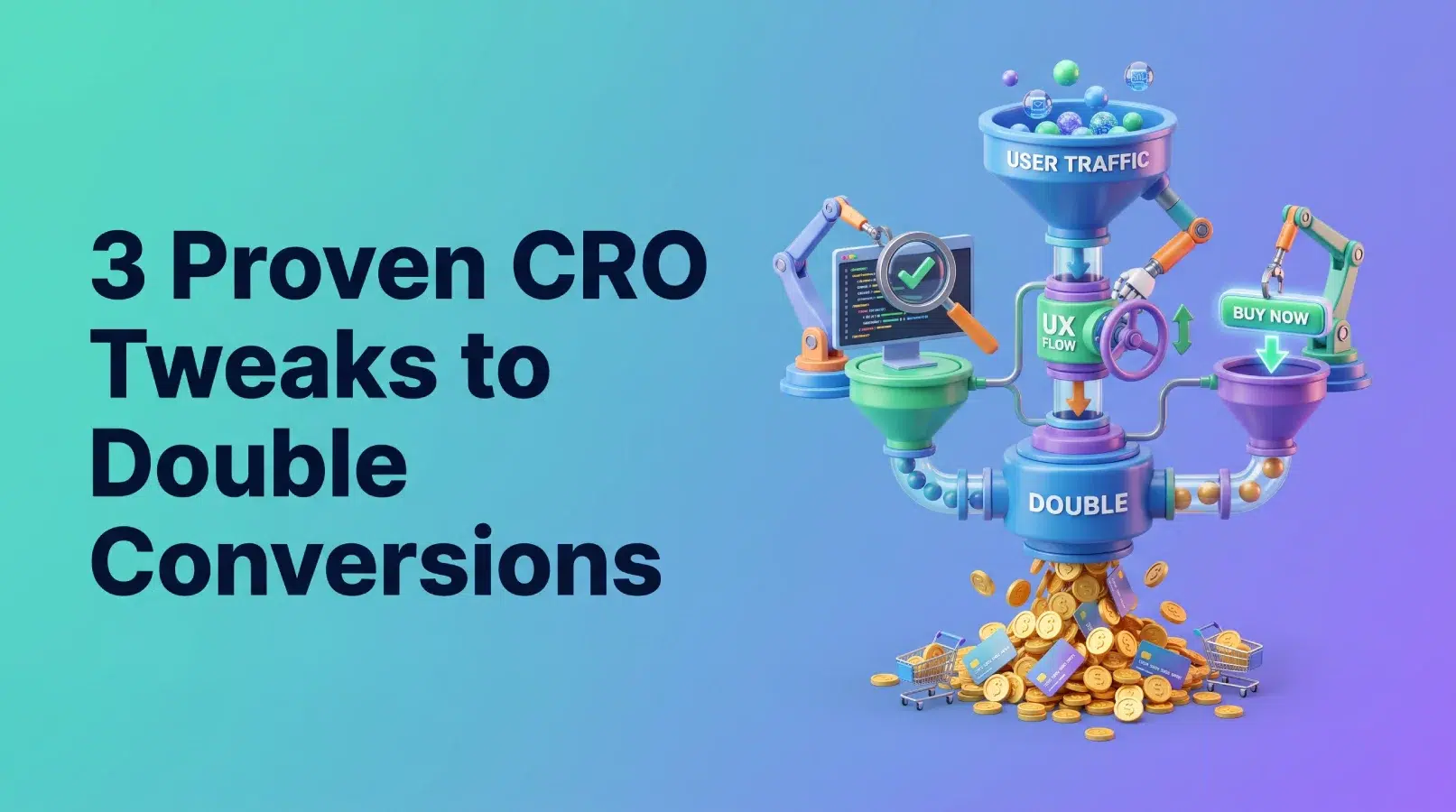
Here are 3 Proven CRO Tweaks to Double Conversions in 2026
Are you struggling to boost your website’s conversion rates? You’re not alone. Many businesses face the challenge of turning website visitors into paying customers. However, with the right CRO tweaks, you can significantly improve your conversion funnel and see a substantial increase in your bottom line. In this article, we’ll explore proven CRO tweaks that can help you double your conversions in 2026.
Mobile devices now account for a significant portion of web traffic, but mobile conversion rates often lag behind desktop rates. This discrepancy arises from several factors. Mobile users often experience friction due to poorly optimized websites, leading to high bounce rates and low conversions. Issues include slow loading times, difficult navigation, and intrusive pop-ups. All of these factors can contribute to a frustrating user experience and ultimately, a lower conversion rate.
To improve mobile conversion rates, it’s crucial to streamline the mobile experience. This involves implementing responsive design, which ensures that your website adapts seamlessly to different screen sizes. Optimizing images for faster loading is also essential, as mobile users are often on slower connections. Simplifying navigation and eliminating intrusive pop-ups on mobile devices are key to enhancing user experience and driving conversions.
💡 Implementing Accelerated Mobile Pages (AMP) can significantly boost your mobile performance. AMP provides a stripped-down version of your content, loading almost instantly on mobile devices. This not only improves user experience but also enhances your website’s visibility in mobile search results. For many of our clients here in Lahore, we’ve seen AMP implementation lead to substantial improvements in mobile engagement and conversion rate optimization.
✅ One often overlooked CRO tweak is optimizing touch targets and spacing on mobile devices. Ensure buttons and links are large enough and spaced appropriately for easy tapping on touchscreens. Small, closely spaced touch targets can lead to accidental clicks and frustration, driving users away from your site. By optimizing these elements, you can create a more user-friendly mobile experience and improve conversion rate optimization.
Generic CTAs like “Submit” or “Learn More” fail to capture user attention and motivate action. They blend into the background and don’t provide a compelling reason for users to click. This leads to low click-through rates and missed conversion opportunities. An uninspired CTA can be the difference between a conversion and a bounce.
Craft CTAs that are benefit-driven, use strong action verbs, and create a sense of urgency or exclusivity. Personalize CTAs based on user behavior or demographics to make them more relevant. This approach increases the likelihood that users will engage with your CTAs and take the desired action, such as making a purchase or filling out a form.
✨ Making your CTAs visually stand out is a crucial CRO tweak. Use contrasting colors that complement your website’s design to draw attention to your CTAs. Strategically place CTAs above the fold or within relevant content sections to ensure they are easily visible to users. We always recommend this strategy to our clients and have seen it drastically improve click-through rates.
➡️ A/B testing is essential for optimizing your CTAs. Experiment with different CTA copy, button designs, and placements to identify the most effective combinations. Test variations that highlight different benefits or create a sense of urgency. We’ve consistently found that even small tweaks in CTA design and copy can have a significant impact on conversions.
Asking for too much information upfront or having a multi-step checkout process can overwhelm users and lead to form abandonment and cart abandonment. Users are often hesitant to provide excessive personal information, especially if they are unsure about the trustworthiness of the website. The longer and more complex the form, the greater the chance that users will abandon it.
Reduce the number of required form fields to only essential information. Offer guest checkout options and simplify the checkout process to minimize friction. Providing a seamless and straightforward checkout experience can significantly reduce cart abandonment rates and increase conversions. Form optimization is key here.
✅ Use progress indicators to show users how far they are in the checkout process. Display trust badges and security certifications to build confidence and reduce anxiety. Showing users their progress helps them feel more in control and less overwhelmed, while trust signals reassure them that their information is secure. This CRO tweak has consistently proven effective in boosting conversions for our clients.
💡 Providing a variety of payment options caters to different user preferences. Offer credit cards, PayPal, and other popular digital wallets. Limiting payment options can alienate potential customers who prefer alternative methods. The more payment options you offer, the more likely you are to capture a wider range of customers and increase your conversion rate.
Lack of social proof can create doubt and uncertainty in potential customers’ minds, hindering their decision to convert. Without seeing evidence that others have had positive experiences with your product or service, potential customers may be hesitant to make a purchase. This can significantly impact your conversion rate optimization.
Showcase positive testimonials, customer reviews, and compelling case studies to build trust and credibility. Use authentic and relatable examples to resonate with your target audience. Social proof can be a powerful motivator, helping potential customers overcome their doubts and feel confident in their decision to convert.
➡️ Implement real-time activity notifications, such as “John from New York just purchased this item,” to create a sense of urgency and social validation. These notifications can make your website feel more dynamic and popular, encouraging potential customers to join in and make a purchase. However, it’s important to use these notifications sparingly and avoid overwhelming users.
✨ Display any relevant awards, certifications, or industry recognitions to enhance your authority and expertise. These accolades demonstrate your credibility and can help build trust with potential customers. We’ve observed that showcasing awards and certifications is a very effective CRO tweak, especially for businesses in competitive industries.
Treating all website visitors the same can result in a disconnected and irrelevant experience, reducing engagement and conversions. Generic content fails to address individual needs and preferences, making it less likely that visitors will find what they’re looking for or feel compelled to take action. This lack of personalization can significantly hinder your landing page optimization efforts.
Personalize website content, product recommendations, and offers based on user demographics, browsing history, and purchase behavior. Tailoring the user experience to individual preferences can significantly increase engagement and conversions. By showing visitors content that is relevant to their interests, you can make them feel more valued and increase the likelihood that they will convert.
✅ Display location-specific information, such as nearby stores or local events, to create a more relevant and personalized experience. This is particularly effective for businesses with physical locations or those targeting specific geographic areas. We often advise our clients to implement location-based content, and we’ve consistently seen positive results in terms of engagement and conversions.
💡 Segment your email list and send targeted email campaigns with personalized content and offers based on user interests and past interactions. Personalized email marketing can be a powerful tool for driving conversions. By sending targeted messages to specific segments of your audience, you can increase the relevance of your emails and improve click-through rates. For our clients here in Lahore, we’ve found that personalized email campaigns significantly outperform generic ones.
Slow website loading times can significantly impact user experience, leading to high bounce rates and decreased conversions. In today’s fast-paced digital world, users expect websites to load quickly and efficiently. A slow-loading website can frustrate users and cause them to abandon your site before they even have a chance to see your content. Website optimization for speed is crucial.
Optimize images, leverage browser caching, and minify CSS and JavaScript files to improve website loading speed. These techniques can help reduce the size of your website’s files and improve the efficiency of your server, resulting in faster loading times. Investing in website optimization is one of the most effective CRO tweaks you can make.
✨ Utilize a CDN to distribute your website’s content across multiple servers, reducing latency and improving loading times for users around the world. A CDN can significantly improve your website’s performance, especially for users who are geographically far from your server. We highly recommend using a CDN to ensure that your website loads quickly for all users, regardless of their location.
➡️ Work with your web hosting provider to optimize database queries and server performance to ensure your website runs smoothly and efficiently. A poorly optimized database or server can significantly slow down your website. By working with your hosting provider to address these issues, you can improve your website’s performance and reduce loading times. This is a critical aspect of CRO strategies.
Poor website navigation can frustrate users and make it difficult for them to find the information they need, leading to high bounce rates and missed conversions. A confusing or poorly organized website can leave users feeling lost and overwhelmed, causing them to abandon your site in frustration. Effective user experience (UX) is essential here.
Simplify your website’s navigation menu, use clear and descriptive labels, and organize content logically to make it easy for users to find what they’re looking for. A well-designed navigation system should be intuitive and easy to use, allowing users to quickly and efficiently find the information they need. This directly impacts user experience (UX) and conversion rate optimization.
✅ Use breadcrumb navigation to show users their current location on your website and provide a clear path back to the homepage. Breadcrumbs can be a helpful way to orient users and make it easier for them to navigate your website. We’ve found that implementing breadcrumb navigation can improve user experience (UX) and reduce bounce rates.
💡 Conduct user testing to identify any usability issues or areas of confusion within your website’s navigation. User testing can provide valuable insights into how users interact with your website and identify any areas that need improvement. We always recommend conducting user testing as part of our CRO strategies.
Making changes without data to back them up. Relying on intuition alone can lead to ineffective optimizations and wasted resources. Without proper testing, it’s impossible to know whether your changes are actually improving your conversion funnel or simply a waste of time.
Test all changes, big or small. A/B testing allows you to compare different versions of your website or landing page to see which one performs better. By testing even minor changes, you can ensure that your CRO tweaks are based on data rather than guesswork.
✨ Isolate the variable for accurate data. When conducting A/B testing, it’s crucial to test only one element at a time. This allows you to accurately measure the impact of that specific change and avoid confounding results. Testing multiple elements simultaneously can make it difficult to determine which change is responsible for the observed results.
➡️ Ensure your results are meaningful. Before making any decisions based on A/B testing results, it’s important to ensure that the results are statistically significant. This means that the observed difference between the two versions is unlikely to be due to random chance. Using statistical significance ensures that your optimizations are based on reliable data.
Images without descriptive alt text are invisible to search engines and inaccessible to users with visual impairments. This represents a missed opportunity to improve your website’s SEO and provide a better user experience (UX) for all users.
Write clear and concise alt text for all images on your website, using relevant keywords to improve SEO and provide context for screen readers. Alt text should accurately describe the content and purpose of the image, making it accessible to users with visual impairments and helping search engines understand the context of the image.
✅ Incorporate your target keywords into your alt text where appropriate, but avoid keyword stuffing. While it’s important to include relevant keywords in your alt text, it’s equally important to avoid overdoing it. Keyword stuffing can be detrimental to your SEO efforts and can make your alt text sound unnatural.
💡 Focus on accurately describing the content and purpose of the image to provide valuable context for users and search engines. The primary goal of alt text is to provide a clear and concise description of the image, making it accessible to all users and helping search engines understand the context of the image. This improves overall website optimization.
Without understanding how users interact with your website, it’s difficult to make informed decisions about optimization. Making changes without user insight is like shooting in the dark – you may get lucky, but you’re more likely to miss the mark. Effective CRO strategies rely on understanding user behavior.
Implement heatmaps and analytics tools to track user behavior, identify areas of interest, and uncover pain points. Heatmaps and analytics can provide valuable insights into how users are interacting with your website, allowing you to make data-driven decisions about optimization. This is key for effective landing page optimization.
✨ Use click maps to see where users are clicking on your website and identify the most popular areas and elements. Click maps can reveal which areas of your website are attracting the most attention and which areas are being overlooked. This information can help you optimize your call to action placement and improve conversion rate optimization.
➡️ Monitor scroll depth to see how far users are scrolling down your pages and identify areas where engagement drops off. Tracking scroll depth can help you identify areas of your website where users are losing interest. This information can help you optimize your content and design to improve engagement and reduce bounce rates.
A weak or unclear value proposition fails to communicate the unique benefits of your product or service, leading to lost sales. If potential customers don’t understand what makes your product or service better than the competition, they are unlikely to choose you. Clarity in your value proposition is crucial for conversion rate optimization.
Clearly communicate the unique benefits of your product or service and explain how it solves your customers’ problems. A compelling value proposition should be concise, easy to understand, and highlight the key differentiators that set you apart from the competition. This is fundamental to effective CRO strategies.
✅ Use concise and benefit-driven language to articulate your value proposition in a clear and compelling way. Avoid jargon and focus on the specific benefits that your product or service offers to your customers. Clarity and conciseness are key to a strong value proposition.
💡 Emphasize what makes your product or service different from the competition and why customers should choose you. Identifying and highlighting your key differentiators can help you stand out in a crowded marketplace and attract more customers. This is a critical aspect of landing page optimization.
A significant portion of online shoppers abandon their carts before completing their purchase, resulting in lost revenue. Cart abandonment is a common problem for e-commerce businesses, but it doesn’t have to be a permanent loss. CRO strategies should always include retargeting.
Use retargeting campaigns to re-engage abandoned cart users and encourage them to complete their purchase. Retargeting allows you to show ads to users who have previously visited your website or added items to their cart but didn’t complete the purchase. This is a powerful way to recover lost sales and improve your conversion funnel.
✨ Offer incentives, such as free shipping or a discount code, to encourage abandoned cart users to complete their purchase. Incentives can be a powerful motivator for users who are on the fence about completing their purchase. A small discount or free shipping can be enough to push them over the edge and finalize the transaction.
➡️ Personalize your retargeting ads based on the specific items that were left in the abandoned cart. Personalizing your retargeting ads can make them more relevant and effective. Showing users the specific items they left in their cart can remind them of their initial interest and encourage them to complete the purchase.
“Conversion rate optimization is not about doing more; it’s about doing things that matter.” – Khalid Farhan
In summary, implementing these 12 CRO tweaks can significantly improve your website’s conversion rates. From addressing mobile usability nightmares to simplifying form fields and leveraging social proof, each tweak focuses on enhancing the user experience and motivating visitors to take action. Remember to A/B testing everything to ensure your changes are data-driven and effective.
Conclusion
By implementing these proven CRO tweaks, you can create a more user-friendly and persuasive website that converts more visitors into customers. Remember that conversion rate optimization is an ongoing process, and continuous testing and refinement are essential for achieving long-term success. These strategies are a cornerstone of the services we offer at SkySol Media, and we’re confident that they can help you achieve your business goals. We’re here to help guide you through these processes, offering our expertise and support every step of the way.
FAQ Section
Q: What is conversion rate optimization (CRO)?
A: Conversion rate optimization (conversion rate optimization) is the process of improving your website or landing page to increase the percentage of visitors who take a desired action, such as making a purchase or filling out a form.
Q: Why is CRO important?
A: CRO strategies are important because it allows you to get more value from your existing website traffic. By improving your conversion rate, you can increase your revenue without necessarily increasing the number of visitors to your site.
Q: What are some common CRO techniques?
A: Some common CRO tweaks include improving website speed, simplifying navigation, optimizing call to action buttons, leveraging social proof, and personalizing the user experience.
Q: How do I measure the success of my CRO efforts?
A: You can measure the success of your CRO strategies by tracking your conversion rate, bounce rate, time on site, and other relevant metrics. A/B testing is also a crucial tool for measuring the impact of specific changes.
Q: How long does it take to see results from CRO?
A: The time it takes to see results from CRO tweaks can vary depending on the complexity of your website and the changes you are implementing. However, with consistent testing and optimization, you should start to see improvements in your conversion rate within a few weeks or months.
Q: What is A/B testing and why is it important for CRO?
A: A/B testing is a method of comparing two versions of a webpage or app against each other to determine which one performs better. It’s important for CRO strategies because it allows you to make data-driven decisions about optimization, rather than relying on guesswork.
Q: How can I improve my mobile conversion rate?
A: To improve your mobile conversion rate, focus on optimizing your website for mobile devices, including using responsive design, optimizing images for faster loading, and simplifying navigation. Implementing Accelerated Mobile Pages (AMP) can also significantly boost your mobile performance. Mobile website optimization is key.
Q: What is a call to action (CTA) and why is it important?
A: A call to action (CTA) is a button or link that encourages users to take a specific action, such as making a purchase or filling out a form. CTAs are important because they guide users through your conversion funnel and help you achieve your business goals.
Q: How can I create compelling CTAs?
A: To create compelling CTAs, use strong action verbs, create a sense of urgency or exclusivity, and make your CTAs visually stand out by using contrasting colors and prominent placement. A/B testing different CTA copy and designs is also essential for optimization.
Q: What is form optimization and why is it important?
A: Form optimization is the process of improving the design and functionality of your website forms to increase the number of users who complete them. It’s important because it can significantly reduce form abandonment rates and improve your overall conversion rate.
Q: How can I simplify my form fields?
A: To simplify your form fields, reduce the number of required fields to only essential information, offer guest checkout options, and implement progress indicators and trust signals. This improves the user experience (UX).
Q: What is social proof and why is it important for CRO?
A: Social proof is the concept that people are more likely to take an action if they see that others have already done so. It’s important for CRO strategies because it builds trust and credibility, which can help overcome potential customers’ doubts and encourage them to convert.
Q: How can I leverage social proof on my website?
A: You can leverage social proof on your website by showcasing positive testimonials, customer reviews, and compelling case studies. Displaying real-time activity notifications and showcasing awards and certifications can also enhance your authority and expertise.
Q: What is personalization and why is it important for CRO?
A: Personalization is the process of tailoring the user experience to individual preferences and behaviors. It’s important for CRO strategies because it can significantly increase engagement and conversions by making your website more relevant and appealing to each visitor.
Q: How can I personalize the user experience on my website?
A: You can personalize the user experience on your website by tailoring content based on user data and behavior, implementing dynamic content based on location, and using personalized email marketing campaigns. This improves the overall user experience (UX).
Q: What is website speed and why is it important for CRO?
A: Website speed refers to the amount of time it takes for your website to load. It’s important for CRO strategies because slow loading times can significantly impact the user experience (UX), leading to high bounce rates and decreased conversions. Website optimization for speed is critical.
Q: How can I improve my website’s speed?
A: To improve your website’s speed, optimize images, leverage browser caching, minify CSS and JavaScript files, use a Content Delivery Network (CDN), and optimize database queries and server performance.
Q: What is website navigation and why is it important for CRO?
A: Website navigation refers to the way users find their way around your website. It’s important for CRO strategies because confusing or difficult navigation can frustrate users and make it difficult for them to find the information they need, leading to high bounce rates and missed conversions.
Q: How can I improve my website’s navigation?
A: To improve your website’s navigation, simplify your navigation menu, use clear and descriptive labels, organize content logically, and implement breadcrumb navigation. Conducting user testing to identify navigation issues is also helpful.
Don’t forget to share it

We’ll Design & Develop a Professional Website Tailored to Your Brand
Enjoy this post? Join our newsletter
Newsletter
Related Articles
CRO Services WordPress: Proven Ways to Save Your Website in 2025
CRO Services: The Ultimate Guide to Stop Leaking Money in 2025
CRO Services: The Amazing 2025 Guide to Stop Website Leaks
CRO Services: The Ultimate Guide to Amazing Growth in 2025
CRO Services: The Amazing 2025 Guide to Boost Conversions
Amazing CRO Services: Ultimate Guide to Website Transformation in 2025
SkySol Media
We firmly believe that the internet should be available and accessible to anyone, and are committed to providing a website that is accessible to the widest possible audience, regardless of circumstance and ability.
To fulfill this, we aim to adhere as strictly as possible to the World Wide Web Consortium’s (W3C) Web Content Accessibility Guidelines 2.1 (WCAG 2.1) at the AA level. These guidelines explain how to make web content accessible to people with a wide array of disabilities. Complying with those guidelines helps us ensure that the website is accessible to all people: blind people, people with motor impairments, visual impairment, cognitive disabilities, and more.
This website utilizes various technologies that are meant to make it as accessible as possible at all times. We utilize an accessibility interface that allows persons with specific disabilities to adjust the website’s UI (user interface) and design it to their personal needs.
Additionally, the website utilizes an AI-based application that runs in the background and optimizes its accessibility level constantly. This application remediates the website’s HTML, adapts Its functionality and behavior for screen-readers used by the blind users, and for keyboard functions used by individuals with motor impairments.
If you’ve found a malfunction or have ideas for improvement, we’ll be happy to hear from you. You can reach out to the website’s operators by using the following email
Our website implements the ARIA attributes (Accessible Rich Internet Applications) technique, alongside various different behavioral changes, to ensure blind users visiting with screen-readers are able to read, comprehend, and enjoy the website’s functions. As soon as a user with a screen-reader enters your site, they immediately receive a prompt to enter the Screen-Reader Profile so they can browse and operate your site effectively. Here’s how our website covers some of the most important screen-reader requirements, alongside console screenshots of code examples:
Screen-reader optimization: we run a background process that learns the website’s components from top to bottom, to ensure ongoing compliance even when updating the website. In this process, we provide screen-readers with meaningful data using the ARIA set of attributes. For example, we provide accurate form labels; descriptions for actionable icons (social media icons, search icons, cart icons, etc.); validation guidance for form inputs; element roles such as buttons, menus, modal dialogues (popups), and others. Additionally, the background process scans all the website’s images and provides an accurate and meaningful image-object-recognition-based description as an ALT (alternate text) tag for images that are not described. It will also extract texts that are embedded within the image, using an OCR (optical character recognition) technology. To turn on screen-reader adjustments at any time, users need only to press the Alt+1 keyboard combination. Screen-reader users also get automatic announcements to turn the Screen-reader mode on as soon as they enter the website.
These adjustments are compatible with all popular screen readers, including JAWS and NVDA.
Keyboard navigation optimization: The background process also adjusts the website’s HTML, and adds various behaviors using JavaScript code to make the website operable by the keyboard. This includes the ability to navigate the website using the Tab and Shift+Tab keys, operate dropdowns with the arrow keys, close them with Esc, trigger buttons and links using the Enter key, navigate between radio and checkbox elements using the arrow keys, and fill them in with the Spacebar or Enter key.Additionally, keyboard users will find quick-navigation and content-skip menus, available at any time by clicking Alt+1, or as the first elements of the site while navigating with the keyboard. The background process also handles triggered popups by moving the keyboard focus towards them as soon as they appear, and not allow the focus drift outside it.
Users can also use shortcuts such as “M” (menus), “H” (headings), “F” (forms), “B” (buttons), and “G” (graphics) to jump to specific elements.
We aim to support the widest array of browsers and assistive technologies as possible, so our users can choose the best fitting tools for them, with as few limitations as possible. Therefore, we have worked very hard to be able to support all major systems that comprise over 95% of the user market share including Google Chrome, Mozilla Firefox, Apple Safari, Opera and Microsoft Edge, JAWS and NVDA (screen readers).
Despite our very best efforts to allow anybody to adjust the website to their needs. There may still be pages or sections that are not fully accessible, are in the process of becoming accessible, or are lacking an adequate technological solution to make them accessible. Still, we are continually improving our accessibility, adding, updating and improving its options and features, and developing and adopting new technologies. All this is meant to reach the optimal level of accessibility, following technological advancements. For any assistance, please reach out to